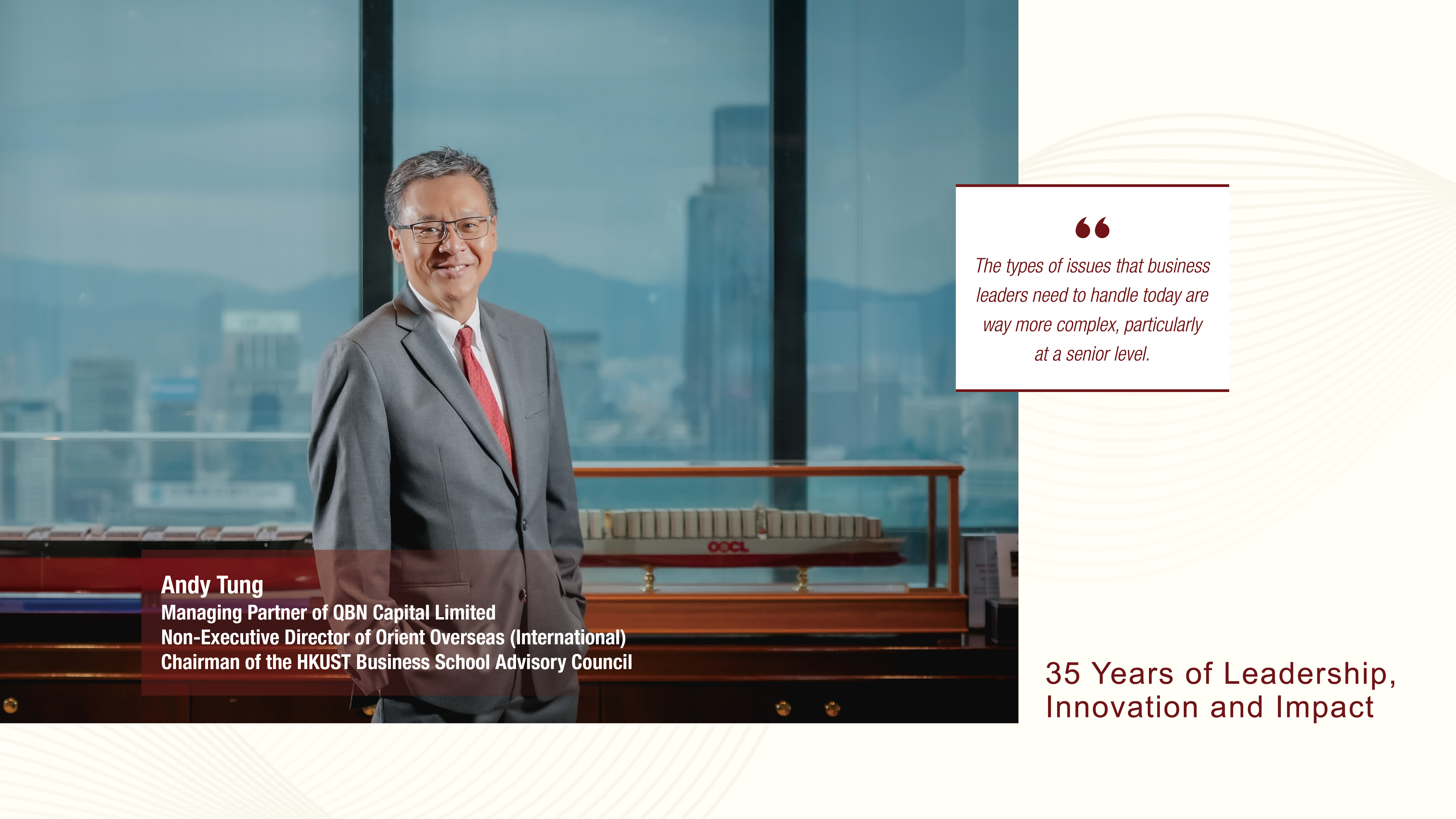
Andy TUNG, Chairman of the HKUST Business School Advisory Council, Managing Partner of QBN Capital Limited and Non-Executive Director of Orient Overseas (International), shares his perspective on how business education must evolve by widening students’ worldview, sharpening their ability to learn amid disruption, and leading with transparency and purpose.
As HKUST Business School marks its 35th anniversary, it stands as one of Asia’s most dynamic academic institutions which has risen in a fashion that is, in the words of School Advisory Council Chairman Andy Tung, “nothing short of stunning” over the past three decades.
With leadership experience gained from a career in the shipping industry, Tung speaks from a vantage point that allows for reflection and foresight, offering insights that reveal how far the School has come and what it must do to keep business education relevant in a rapidly evolving economy.
Over the years, what has impressed him most is the strength and breadth of the ecosystem that has been created. It is seen in the truly international nature of the faculty and the student body, the extensive alumni network, and the variety of programs and research projects built on academic rigor and all-round excellence.
The early decision to develop a large number of international partnerships helped to propel the School to global standing in record time. And that achievement, Tung says, is “a real testimony to the leadership and all the effort and dedication” that has been put in by so many individuals.
There is, of course, nothing accidental about all this. It is the product of openness, ambition, and a willingness to evolve, traits which Tung believes the School must continue to cultivate.
Transparency as a Cultural Foundation
This view has been reinforced during his decade or so on the Advisory Council and, since recently assuming the role of chair, he has been further impressed by these aspects of on-campus culture.
“There is just an exceptional level of transparency, which means we have very open access to the leadership, to the professors. It is a true dialogue,” he says.
So, rather than being a forum to rubber stamp decisions, the Council operates as an active partnership, where ideas are exchanged and feedback genuinely welcomed. Along the way, the process also encourages qualities such as receptiveness and humility.
“Being humble opens your mind to seeing different points of view and learning from others,” Tung says, adding that this is not merely procedural, but signals the University’s willingness to keep learning, adapting, and improving.
A Changing World and Wider Horizons
In his opinion, the School’s past has been defined by growth, but its future will be about dealing with complexity. Today’s leaders confront challenges far different from those of previous generations, and that pattern will continue, though almost certainly with greater speed and intensity.
“We live in a fast-changing world,” Tung says. “The types of issues that business leaders need to handle today are way more complex.”
For instance, geopolitics, once a distant concern for most companies, now shapes daily decision making. Market volatility has intensified. And technology is accelerating the pace of change in ways that few people can really anticipate.
In this environment, the true value of business education lies not in teaching fixed answers, but in developing the mental flexibility and different approaches needed to manage any situation.
“Students must keep expanding their horizons,” Tung says. In particular, it is essential to avoid tunnel vision — the instinct to consider only one’s own market or viewpoint. Graduates must also understand how an event halfway around the world might have repercussions on supply chains, markets, and business models.
Learning How to Learn
Therefore, Tung believes, business schools must teach students how to interpret and anticipate such issues rather than simply absorbing existing knowledge. The ability to understand disruptions, whether economic, geopolitical or relating to technology, and to foresee possible implications will allow future leaders to navigate uncertainty.
To do this, however, practical experience is vital, which makes HKUST’s applied approach, with corporate projects, internships and simulations, one of its greatest strengths. These experiences mirror the sometimes messy realities of business life, giving students the confidence and competencies to operate in fast moving, high stakes environments. The University’s ties with companies on the cutting edge in engineering and science add to this advantage.
“We talk a lot about the importance of tech and innovation, so having these links is very, very important,” Tung says.
Technology’s Constant Impact
He emphasizes too just how profoundly technology will continue to reshape industries. Alluding to his own initial skepticism about the value of camera phones, he now uses this as a reminder of how easy it is to underestimate the impact of shifts in technology. The lesson is that new business models can appear overnight, entire sectors can be upended, and accepted norms can be completely transformed. “For example, the speed of business is much faster now,” Tung says, noting how responses that once took hours or days are now expected within minutes. Leaders must learn to operate within this relentless tempo, and business education must prepare them for it.
Connecting Education to Broader Trends
For HKUST, helping students understand and participate in major macroeconomic trends presents an enormous opportunity. This is especially so in Asia where China’s push up to move up the value chain, its ambition in areas ranging from climate science to AI and robotics, and its “going out” strategy to find new international markets will create a host of new possibilities.
Taking just one of them—green energy—where many countries are seeking sustainable solutions. Hong Kong can play a unique role in financing, exporting, and implementing these technologies. And HKUST can prepare leaders to connect the technical innovations with commercial interests and sales efforts in international markets.
“The chance for cross border collaboration allows businesses to access different ideas, talents, and opportunities,” Tung says, adding that good leadership ultimately rests on character.
“You need to be genuine, transparent, and consistent. You are there to build an organization, a culture that will outlast yourself.”
That mindset engenders trust and will enable graduates to steer organizations through the inevitable cycles of disruption.

Looking Ahead
As HKUST Business School looks to the next stage of development, Tung hopes it will remain bold, open minded, and committed to shaping leaders who can solve problems in Asia and around the world. He also underscores the importance of ethics and a social conscience, emphasizing that graduates must understand not just what technology can do, but what it should do.
“I hope that the School and the University will continue to train students to be aware and understand the importance of these issues, so that they continue to add value as global citizens,” he says. “That is a big job.”