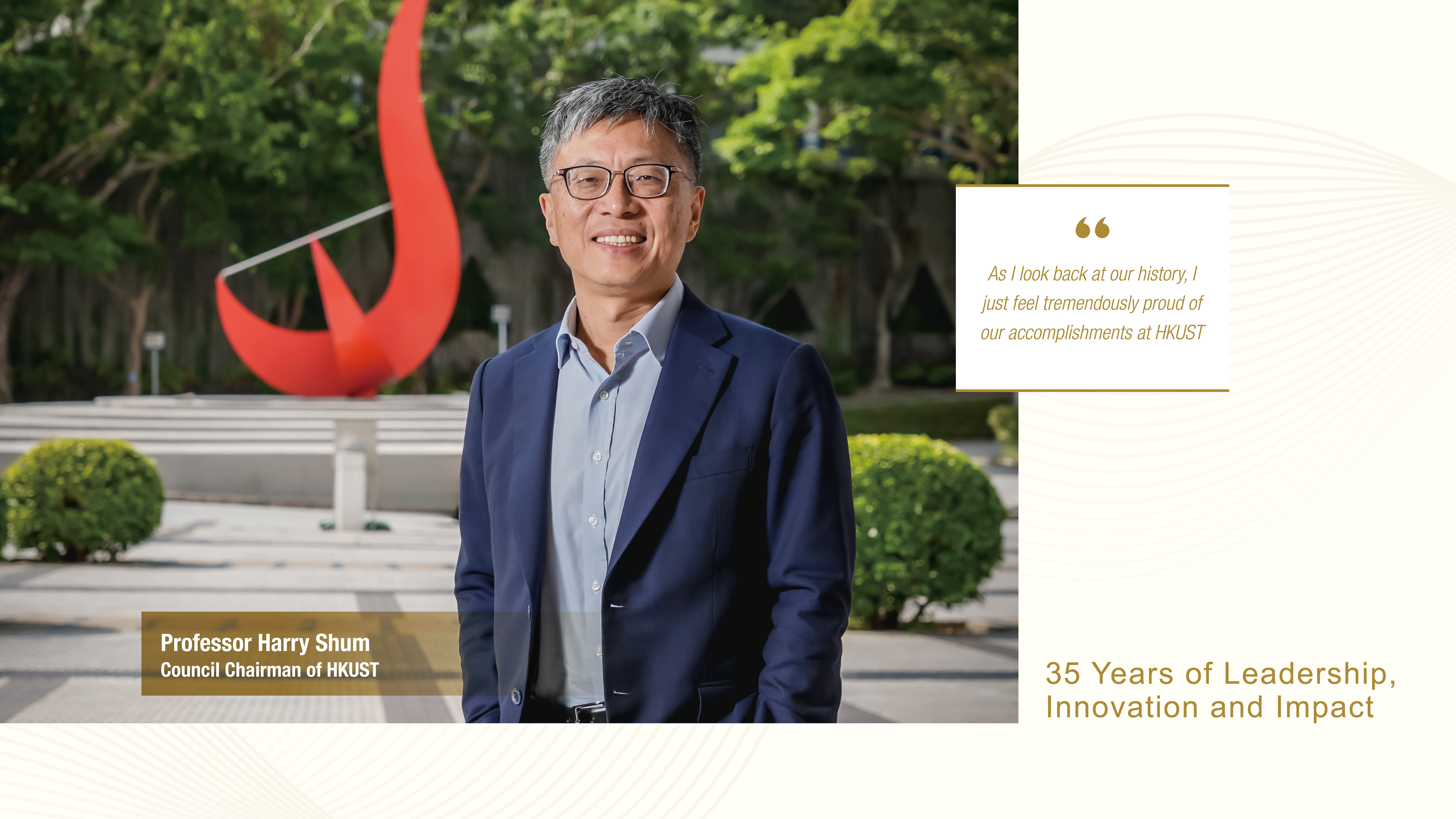
Professor Harry SHUM, Council Chairman of HKUST, reflects on the university’s 35 year journey, its culture of innovation, and how AI, entrepreneurship, and a new chapter in medical education will shape the future.
The view from Clear Water Bay has always inspired bold thinking. On any given day, the HKUST campus hums with ideas — scientists exploring new frontiers, visionaries testing daring concepts, and students chasing the next breakthrough. As the University celebrates its 35th anniversary, it stands at a defining crossroads. It is a time to honor the legacy of a generation of dreamers while stepping confidently into a new era marked by artificial intelligence (AI), entrepreneurship and the recently announced establishment of Hong Kong’s third medical school.
At the heart of this transformation is Council Chairman Professor Harry Shum, whose own journey from a young researcher in Hong Kong to a world renowned technologist and academic leader mirrors HKUST’s story of vision, persistence, and reinvention.
In reflecting on his decades long relationship with the University, and the forces that have shaped its rise, his insights reveal how HKUST has become a center of innovation and a community built on integrity, curiosity, and a shared belief that knowledge must serve humanity.
A Serendipitous Beginning
The Chairman’s first encounter with HKUST occurred in Pittsburgh in 1995. “Professor Roland CHIN (Professor Emeritus at the Department of Computer Science & Engineering) actually came to Carnegie Mellon University on a snowy day, and stopped by my lab to check out my demos,” Professor Shum recalls. “He was trying to recruit me, so that started my long term relationship with the University.”
Though Professor Shum’s career path subsequently took him to Microsoft Research in Seattle, then as Managing Director of Microsoft Research Asia in Beijing and later back to Seattle as Executive Vice President working on product and business at Microsoft Corporation, the idea of collaborating with academia and HKUST remains close to his heart.
He was offered the position of adjunct faculty at universities like Tsinghua and HKUST. Over the years, Professor Shum has supervised over 40 PhD students, some of them from HKUST, who went on to become successful innovators and faculty leaders. Today, he takes the title Professor-at-large Emeritus at Institute of Advanced Study, and continues to supervise PhD students, a testament to his belief that a University’s strength lies in its people.
One of his most touching moments came when he was bestowed an HKUST Honorary Fellowship in 2011. “I had the honor to receive it from the late Honourable Sir CHUNG Sze-Yuen (founding Council Chairman of HKUST),” he says with humility and fondness.
“As I look back at our history, I just feel tremendously proud of our accomplishments at HKUST. The Business School, which rose so quickly to international standing, is a shining example. We pushed the envelope and helped move all of Hong Kong’s higher education forward.”
Overall, he attributes the University’s success to an interdisciplinary mindset that allows for fluid boundaries between science, technology and business. “If you look at Stanford or MIT, they both integrate technology and business well. That is how great ideas can be nurtured into real impact.”
Today, with more than 100,000 alumni and a reputation that rivals much older Universities, HKUST’s influence extends across the globe. “Our graduates, the companies they build, and the communities they serve are the true measure of our achievements,” he says. “We are helping to change society for the better.”
A New Chapter: Expanding Horizons
Amid its milestone year, HKUST has been able to celebrate a notably historic moment, with HKSAR Government’s approval for the University to establish the city’s third medical school. Professor Shum calls it a “pivotal step” that will broaden HKUST’s social impact. By uniting medical instruction with hallmark strengths in science, engineering, AI, and the humanities, HKUST will strive to train doctors who are “clinically outstanding, yet technology savvy and with humility.”
Entrepreneurship as a Mindset
Those developments also chime with the spirit of entrepreneurship, which is so evident in so much of what the University does. “Owning things in your own hands and doing them end to end—that defines success,” he says. He believes the ability to build things from scratch, a willingness to take risks, and a keenness to tackle real issues with social impact, is what sets HKUST students apart.
To nurture that spirit, Professor Shum has championed initiatives such as the Redbird Innovation Fund, an internal venture platform that invests directly in HKUST people. “The idea was simple: invest in your own community,” he explains. “Even if a project fails, the endeavor offers plenty of learning opportunities and makes the entrepreneur stronger. That’s worth it.”
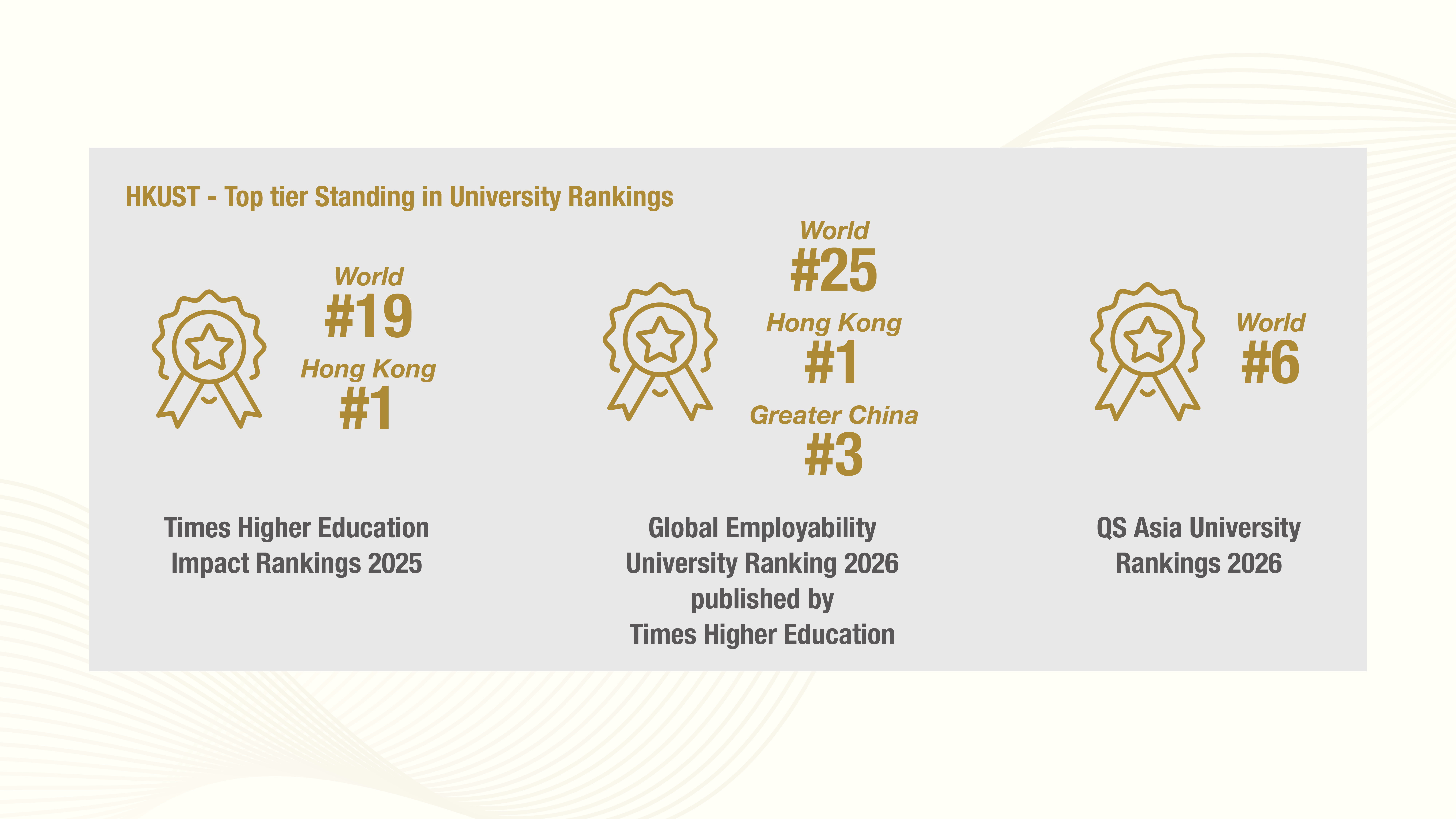
Further proof of that culture of fearless creation can be found in corporate success stories like that of drone manufacturer DJI. “Our influence doesn’t come from being at or near the top of various rankings,” he says. “It comes from what our people build and how they serve others around the world.”
Riding the Wave of Change
When considering the future of education more broadly, Professor Shum is quick to mention the power and challenges of AI. Indeed, the first thing he did as Chairman was to approve a HK$250 million computing budget for the purchase of 500 GPUs to ensure more students and faculty could participate in an on-campus “AI for Science” initiative.
However, progress in this respect must always be anchored in ethics and empathy. “AI is everywhere, but the big question is how do we think about the related ethical issues,” he says. “This is something our shared humanity must face together.” To that end, HKUST has joined the global Partnership on AI — the only member institution from Greater China — affirming its role as a voice for responsible innovation.
Students at the Heart of It All
Despite his focus on technology and policy, Professor Shum always circles back to what he calls HKUST’s single “product”: its students. “The University has only one most important product. It’s our students,” he repeats with conviction. “So how good is your University? You simply ask—how good are your students?”
He believes academic achievement is only half the story. “When you’re still on campus, connect and network with one another—that’s very important,” he advises. “In the AI era, it’s tempting to think you can do everything alone or with technology. But we live in society where you have to collaborate, empathize, and engage with real people.”
Equally vital in that context is the art of questioning. “AI can provide answers,” he says. “What matters now is how well you ask questions and how you use critical thinking and creativity to make AI work for you.”
Purpose and Progress
In his view, the way ahead for individuals and the institution as a whole will require the courage to innovate, a commitment to excellence, and a belief that technology guided by humanity can transform society.
“We must ride the AI wave—that’s the future,” he says. “Our University’s impact depends on what we build for the world and how wisely we use it.”
“We stand ready to shape not only Hong Kong’s educational landscape but the global future of learning, discovery, and care—continuing to bridge legacy and vision in pursuit of a smarter, kinder, and more resilient world.”