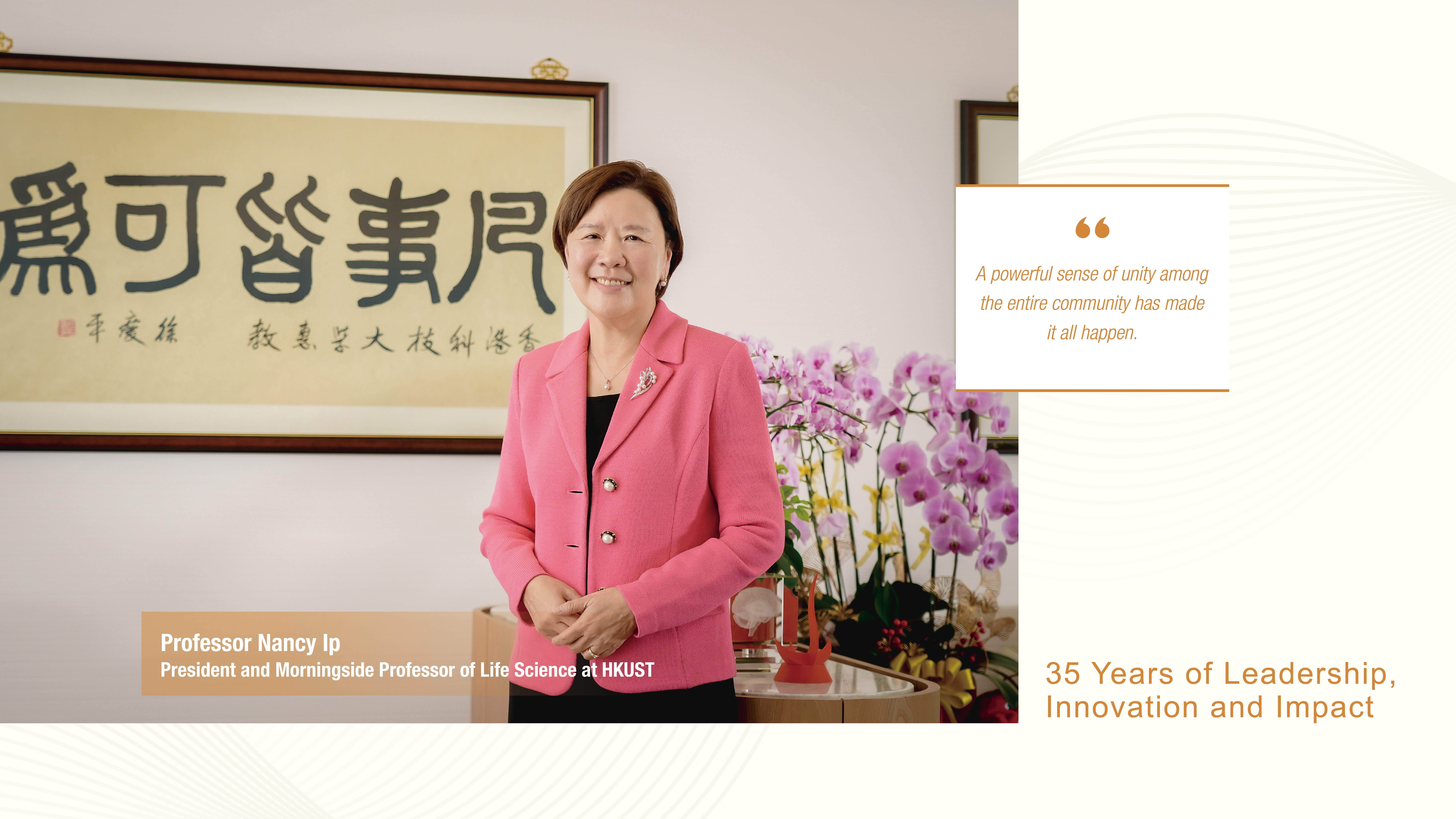
Professor Nancy IP, President and Morningside Professor of Life Science at HKUST, reflects on the University’s evolution from humble beginnings to a globally recognized powerhouse of research, innovation, and collaboration —and on the people and principles that made it possible.
As HKUST celebrates its 35th anniversary, students, alumni, and partners around the world can look back with pride on a journey that has turned a fledgling institution into a center of academic excellence, innovative research, and entrepreneurial drive.
Going from one academic building and a few student hostels in 1991 to ranking among the world’s top 50 universities, HKUST’s story is one of belief, persistence, and community spirit. Over 100,000 graduates have now embarked on the next chapter of their lives, each taking with them the University’s enduring “can-do” spirit and will to succeed.
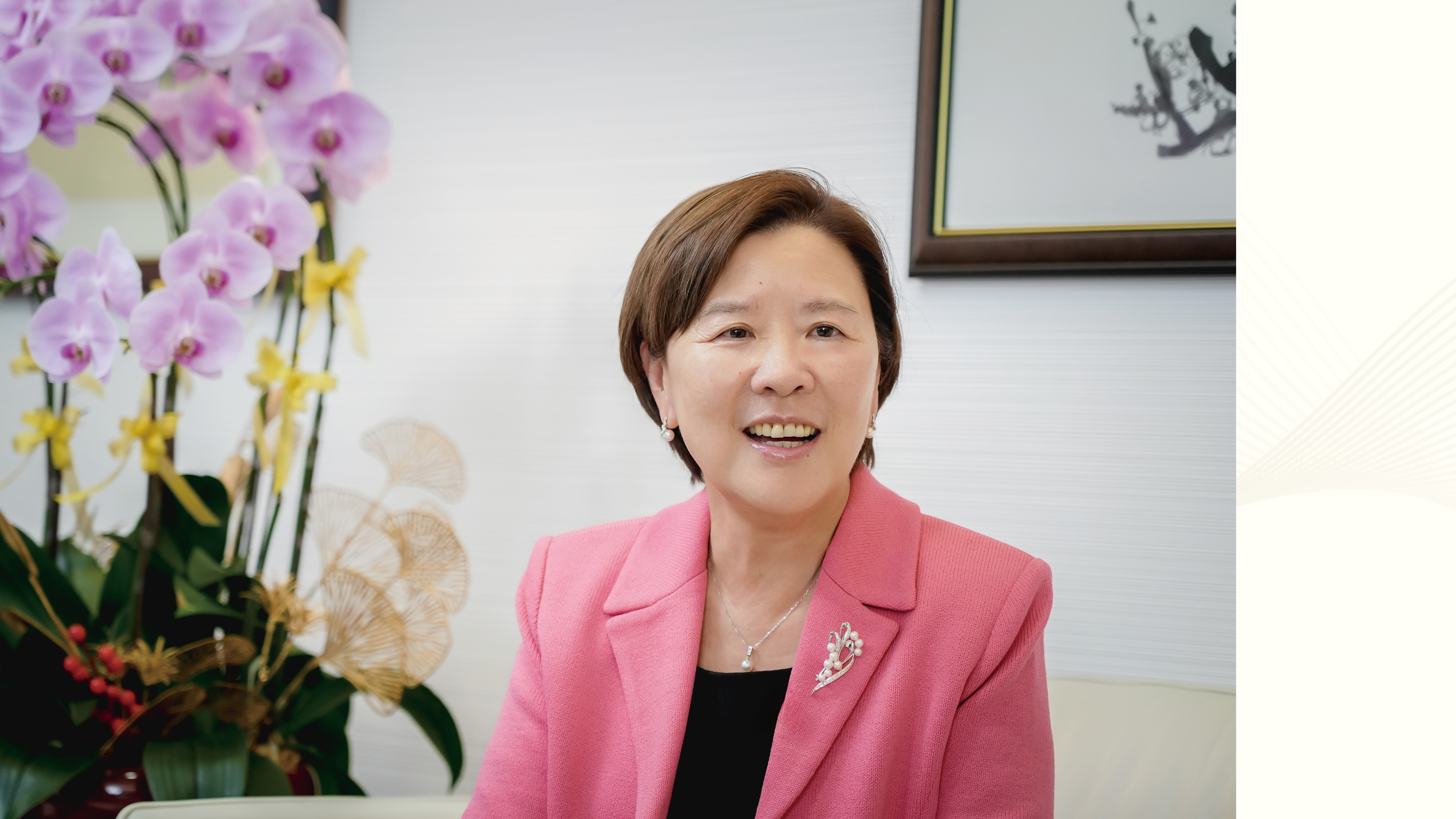
A major player in this remarkable rise is Professor Nancy Ip, President of HKUST and Morningside Professor of Life Science. A world-renowned neuroscientist and the University’s first female president, Professor Ip’s personal journey has been closely intertwined with HKUST’s own evolution.
“It was a very compact sort of environment in the early days,” she recalls. “In Hong Kong it was barely known, and outside Hong Kong it was virtually unknown. When I gave talks at international conferences, people thought I was from Hong Kong U.”
Building from a Vision
Those modest beginnings, though, were fertile ground for big ideas. “Our founding president had the vision to establish HKUST as the first research-intensive university in Hong Kong,” she says. “Joining a new institution gave me opportunities to grow with it and take part in many exciting developments.”
Three decades on, the original vision has been more than realized. The University has come a long way and the long list of achievements is a great source of pride to all who have contributed.
“It has been a collective effort of not just the faculty members, but also students, staff, alumni, and our supporters, partners, and donors,” Professor Ip says. “A powerful sense of unity among the entire community has made it all happen.”
People at the Core
Through the years, success has always been about people — and that remains the case today. The aim at the outset was to recruit top academics and administrators in the belief that first-class individuals would attract others of similar caliber. This strategy allowed HKUST to establish strong programs and an international reputation in a relatively short period of time.
The same people-centered philosophy continues to guide the current leadership team, along with the importance of listening to the views of the on-campus community and external parties when key decisions are up for discussion.
“When I took on this role in 2022, I told myself that all of us have a big responsibility,” says Professor Ip, who viewed her appointment as an honor and a challenge. “The main task was to see how we could work together to elevate the University to new heights and achieve even greater success.”
Collaborating Across Disciplines
To that end, HKUST continues to champion interdisciplinary collaboration as the engine of innovation. That is seen as the best way to enhance teaching standards and learning outcomes, as well as to drive research initiatives and find viable solutions to real-world problems.
As an example, while Professor Ip was the Dean of Science, this interdisciplinary approach inspired a collaboration with the Business School to launch the Biotechnology and Business (BIBU) undergraduate program, which equips students with both life science and business skills, giving them a head start across diverse industries.
Encouraged by the success of the BIBU, HKUST has expanded cross-disciplinary offerings with new programs in financial technology, entrepreneurship, and sustainability. Each is designed and structured to prepare students for careers in complex industries where change is a constant.
Driving Innovation and Entrepreneurship
As a vibrant hub for innovation, HKUST also established Hong Kong’s first Technology Transfer Center and Entrepreneurship Center, where practical support is provided to more than 1,900 active start-ups, including ten unicorns.
“Our patent utilization rate is 33% — on par with MIT and Stanford,” Professor Ip notes. “That is something we can be proud of because such benchmarks signal not just research excellence, but also effective pathways to commercialization and societal value.”
Within this ecosystem, the HKUST Business School plays a pivotal role. It serves as a catalyst in driving entrepreneurial transformation in Hong Kong and further afield, which not only sparks ambition, but also helps to translate research discoveries into worthwhile business ventures.
Science, Leadership, and the ‘Can-Do’ Spirit
Before assuming the presidency, Professor Ip achieved global recognition for her groundbreaking neuroscience research. She still clearly remembers long days working alone in the lab, then gradually building a team, and in 2001, publishing the first paper from China in Nature Neuroscience.
Those experiences continue to shape her approach as a leader. “As a scientist, you are trained to ask questions, form hypotheses, do experiments. They don’t always work, so we also need perseverance,” she explains. “One of the core HKUST values that I often cite is the ‘can-do’ spirit; it is similar to what scientists have to embody. And in a university setting, collaboration within and across disciplines is the key to achieving our goals.”
Universities with Purpose
She emphasizes that the role of a university extends beyond academia. There is a responsibility to be relevant to society, which should be clearly articulated as part of the vision and mission, and make a positive impact through outreach, mentorship, and knowledge transfer. In this manner, HKUST ensures that education and research remain powerful forces for social good, while strengthening Hong Kong’s role as a regional and global innovation hub.
A Bright Future Ahead
In marking the University’s 35th year, Professor Ip wants to reflect, but also push forward with renewed momentum. “We should celebrate our legacy, what we have achieved, but at the same time, we should also focus on the future.”
As part of that future, HKUST has received the HKSAR Government’s approval to establish Hong Kong’s third medical school—an initiative that will integrate clinical training with the University’s strengths in science, engineering, and technology to advance healthcare innovation and talent development in the city.
“While honoring our historic achievements, we will use this anniversary as a platform to advocate for HKUST’s aspirations, reinforcing our role as a thought leader on the global stage. We aim to strengthen our impact and partnerships, within the HKUST family and through our global networks, to showcase our commitment to innovation, research, and service to society.”