Two knowledge exchange events at HKUST Business School, one delivered in Chinese and the other two in English with faculty of HKUST and beyond, invited participants to look beyond conventional wisdom, exploring the forces behind investment returns, the wider effects of financial regulation, the paradox of workplace expectations, as well as Japan’s innovation ecosystem.
Beyond Stock-Picking
What really drives long-term investment returns? Research suggests that 80% of portfolio returns come from asset allocation, not stock-picking or market timing.
Hosted by the School’s China Strategy Team, the newly launched Chinese-language series, “In Pursuit of Insight Forum – 灣區問道,” connects HKUST with the wider community, offering entrepreneurs and lifelong learners fresh perspectives on business and beyond. Held every one to two months, each session will feature scholars and industry experts, with live Q&A helping translate academic research into practical business insights.
Its inaugural event in October featured Prof. LOU Dong of the Finance Department, who shared insights into sustainable long-term investment. According to his research, around 80% of portfolio returns come from beta allocation rather than alpha‑driven stock‑picking or timing. He also discussed inter‑temporal asset hedging and reminded audiences that corporate profits stem from scarcity, drawing comparisons between today’s AI investment surge and America’s historic railway boom.
The forum’s second instalment, scheduled for November 13, will examine AI trends linking Silicon Valley and the Greater Bay Area.

The Hidden Impact of Rules and Norms
The latest BizTalks session examined how rules and organizational norms can shape behavior and outcomes in unexpected ways, from the ripple effects of financial regulation on hedge funds to workplace consequences of disconnecting from work. Attracting more than 100 participants, the session featured two thought-provoking presentations that revealed how pressures on institutions and individuals can extend far beyond their intended effects. .
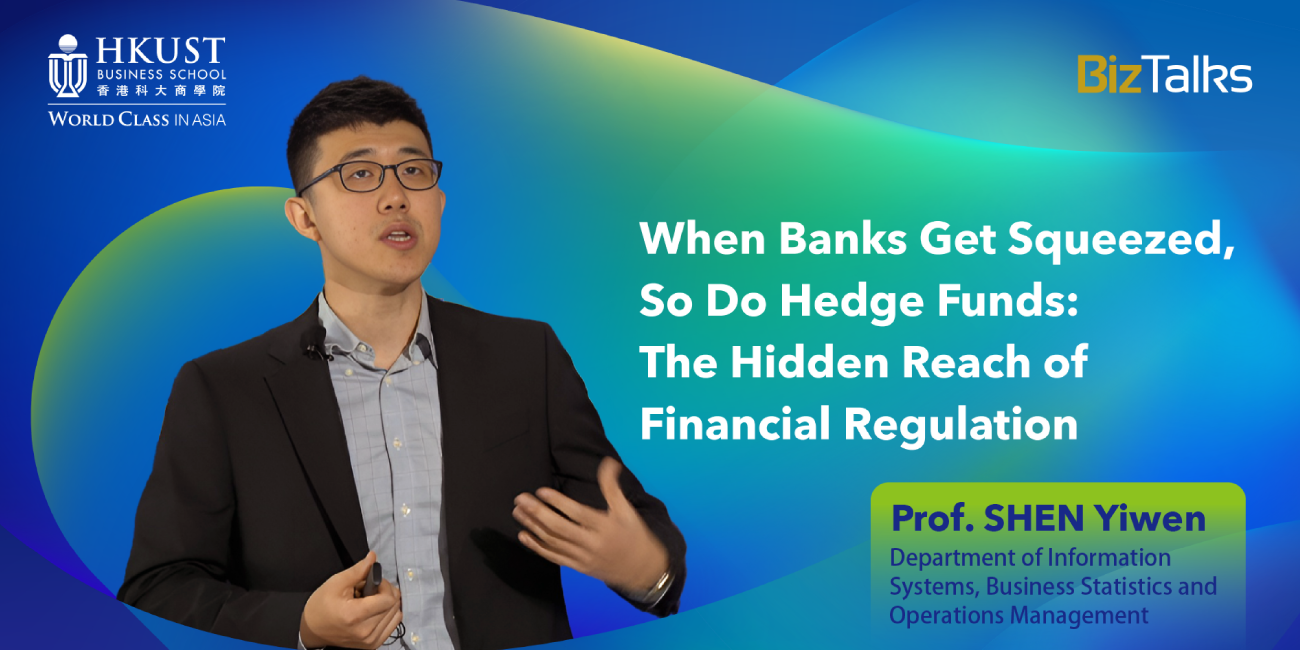
Prof. SHEN Yiwen of the Department of Information Systems, Business Statistics and Operations Management, presented “When Banks Get Squeezed, So Do Hedge Funds: The Hidden Reach of Financial Regulation.” Drawing on the Basel III framework, Prof. Shen examined how constraints on prime brokers’ balance sheets can influence the performance of connected hedge funds. The findings highlighted the broader effects of financial regulation, including its impacts on hedge funds’ returns, risk, leverage costs, and access to financing. Explore his study.
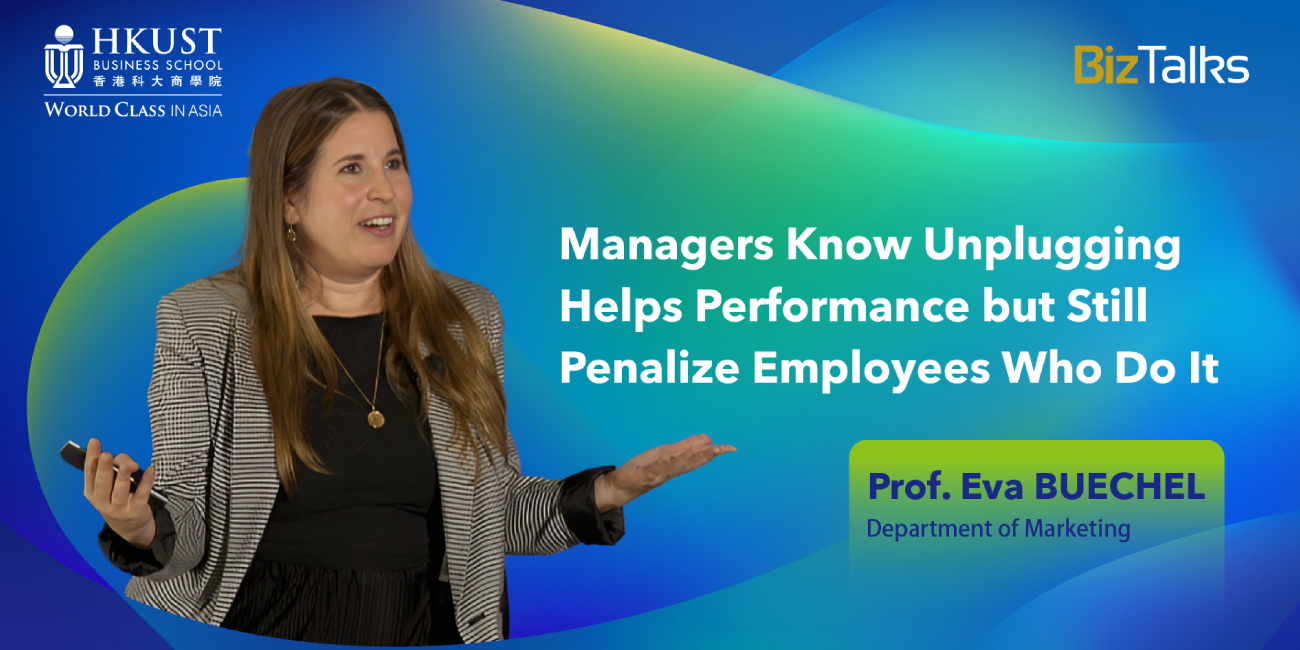
Prof. Eva BUECHEL of the Marketing Department presented “Managers Know Unplugging Helps Performance But Still Penalize Employees Who Do It.” Based on evidence from 16 studies, she explored the “detachment paradox”: although managers recognize that disconnecting from work supports employee well-being and performance, they may still view those who disconnect as less committed and penalize them in promotion decisions. More information here.