


Highlights
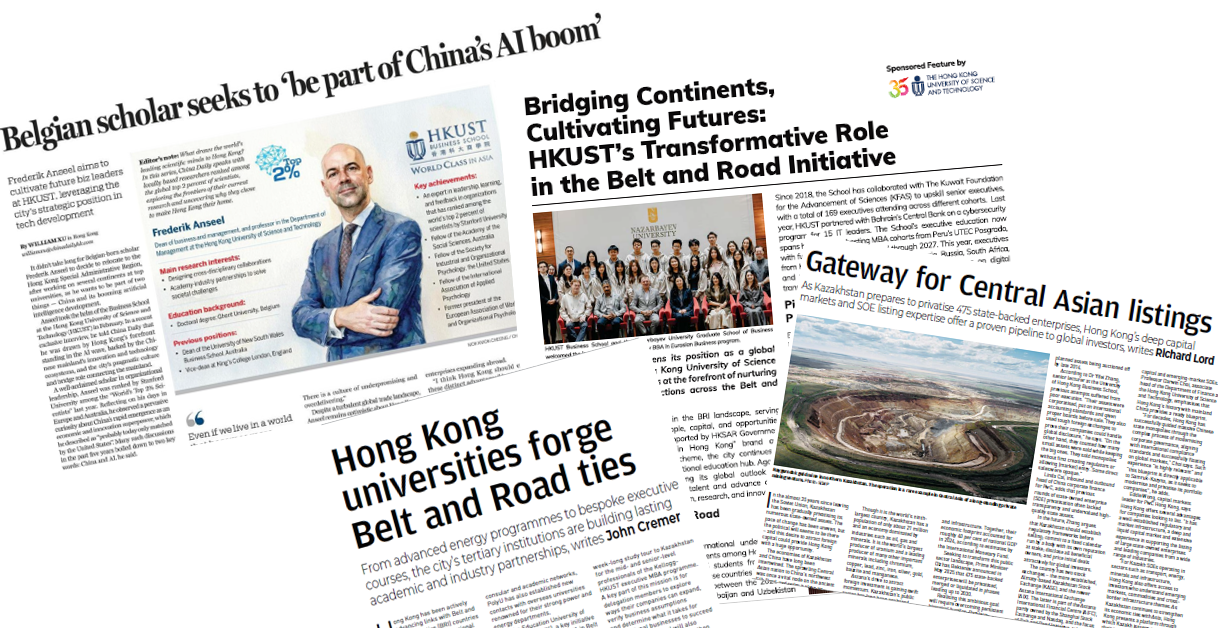
Belgian Scholar Seeks to ‘Be Part of China’s AI boom’ (Sep 4)
In an interview with China Daily, Dean Prof. Frederik Anseel said the opportunity to join HKUST, which excels in technology and AI development, allows him to remain relevant and tap into the Chinese Mainland's thriving technology and innovation ecosystems. He chose to relocate to HK to engage with China and the AI revolution, highlighting the city’s bridge role between China and the world.
Bridging Continents, Cultivating Futures: HKUST's Transformative Role in BRI (Sep 9)
An SCMP advertorial highlighted HKUST’s role as a key architect of talent development under the Belt and Road Initiative (BRI), featuring pioneering efforts by the School in driving executive upskilling in BRI countries, including the MBA program with Saudi Aramco, BBA Program in Eurasian Business and collaborations in executive Education.
HK Universities Power Belt and Road Initiative through Strategic Ties (Sep 9)
In an SCMP article on local universities supporting BRI, it was mentioned that Dean Prof. Frederik ANSEEL is leading a week-long study tour to Kazakhstan for the students from the Kellogg-HKUST Executive MBA program. The delegation aims to explore regional expansion opportunities, validate business assumptions and analyze success factors for international businesses in Central Asia. Prof. Anseel will also leverage the opportunity to strengthen ties with partner institution Nazarbayev University Graduate School of Business to launch Asia's first BBA in Eurasian business.
Kazakhstan’s Privatization Push Offers New IPO Opportunities for HK (Sep 9)
In an SCMP article on Kazakhstan's privatization push offering new IPO opportunities for HK, Prof. Darwin CHOI, Assoc. Head of Dept of Finance, was quoted as saying that HK should represent an ideal IPO destination, offering a proven bridge between international capital and emerging-market state-owned enterprises.
OTHERS
AI Model Training Meets Copyright Protection (Sep 28 )
An HK Economic Journal column article by Assoc. Provost (Academic Development) Prof. HUI Kai-Lung discussed how the surge in physical second-hand book purchases highlights the broader tension between AI development and copyright protection.
How HK’s Old Businesses Are Adapting to New Times (Sep 27 )
In an SCMP article on how HK's old businesses adapt to new times, Director of the Roger King Center for Asian Family Business and Family Office Prof. Winnie PENG cautioned against the assumption that every established company needed to pursue rapid or radical innovation.
US Policies Accelerate China's Rise (Sep 26 )
In a video commentary published in Master Insights YouTube channel, Prof. Emeritus Francis LUI, Dept of Economics, analyzed nine US policies that have alienated international allies and eroded its global influence, while driving tech talent back to China, thereby effectively accelerating China's rise.
Reducing Defense Spending to Ease US Debt Burden (Sep 25)
In a Master Insight column article, Prof. Emeritus Francis LUI, Dept of Economics, explained that servicing the US’s mounting national debt places a severe structural burden on taxpayers, noting that by limiting military intervention and curbing excessive defense expenditures, the country could free up resources to meet a large share of its interest obligations while strengthening public welfare program.
AI Investment Frenzy: The Truth Behind Depreciation and Payback (Sep 25)
HK Economic Times published an article by Prof. Allen HUANG, Head of Dept of Accounting, on the realities of depreciation and investment payback amid the surge in AI computing infrastructure investment.
RMB Internationalization Shifts Toward Risk Management (Sep 25)
In an HK Economic Times column article, Head of HKUST Institute for Financial Research Prof. TANG Bo discussed the evolution of RMB internationalization, from facilitating cross-border settlement to strengthening risk management capabilities.
AI Drives Growth Despite Job Displacement (Sep 24)
In a Master Insight article, Prof. Emeritus Francis LUI, Dept of Economics, analyzed the economic impact of AI, noting that while AI will inevitably displace some jobs, it will not impede economic growth. He added that China is poised to hold a competitive edge over the US in AI development in the long term.
Strengthening Phone Scam Prevention (Sep 21)
An HK Economic Journal column article by Assoc. Provost (Academic Development) Prof. HUI Kai-Lung looked into strategies for combating phone scams targeting non-local students, and proposed measures to ensure students process and absorb crucial fraud-prevention information before arriving in HK.
Investor Disagreement Predicts Lower Market Returns (Sep 19)
An Economic Digest column article by Prof. YU Jialin, Dept of Finance, examined how investor opinion divergence impacts stock prices and returns based on Edward M. Miller's short-sale constraint theory. Using a "bottom-up" approach, the study demonstrates that higher divergence leads to lower future market returns. When comparing stock categories by Book-to-Market ratios, Prof. Yu found that while value premium is more pronounced in high divergence stocks, growth stocks are significantly more sensitive to shifts in opinion divergence.
Remembering Dr. LAM Hang-Chi's Intellectual Openness (Sep 19)
In a Master Insight column article mourning the passing of Dr. LAM Hang-Chi, Prof. Emeritus Francis LUI, Dept of Economics, reminisced about their decade-long relationship, praising Dr. Lam’s open-mindedness and refusal to adopt extreme positions.
Ethical Leadership’s Mixed Effects on Creativity (Sep 19)
HK Economic Journal ran an article by Chair Prof. GONG Yaping, Head of Dept of Management, on the impact of ethical leadership on creativity.
Fiscal Risks Reshape Global Bond Markets (Sep 18)
In an HK Economic Times column article, Head of HKUST Institute for Financial Research Prof. TANG Bo outlined the shifting dynamics of global bond markets and monetary policy following a 25-basis-point interest rate hike by the Federal Reserve. He noted rising U.S. Treasury yields and a national debt exceeding $40 trillion are driving a shift in term premium and fiscal risk premium, bringing concerns over "fiscal dominance" to the forefront.
Quality Over Quantity in University Globalization (Sep 18)
In an article by The Korea Times on a broader shift in university internationalization focusing on quality over recruitment quantity, Prof. LIM Woo Young, Head of Dept of Economics, cautioned that assigning greater weight to international faculty could inadvertently encourage universities to hire foreign teaching-only faculty who conduct little research.
China's South China Sea Strategy (Sep 18)
In a Master Insight column article on China’s land reclamation and island-building efforts in the South China Sea, Prof. Emeritus Francis LUI, Dept of Economics, noted that these actions aim to assert national sovereignty through legal means, strengthen actual control, and counter potential threats posed by US submarines.
HKUST MBA Ranked 4th in Asia (Sep 17)
According reports published in TKWW, Headline 1, Headline 2, Singtao 1 and Singtao 2, the recently released QS Global MBA & Business Master's Rankings 2027, HKUST MBA programs led its local peers by climbing four places to rank 45th globally, 4th in Asia, and 1st in HK, marking its best performance since 2021. HKUST maintained the global top 50 for the indicators of "employability" and "thought leadership," ranking second in Asia for "thought leadership."
AI Adaptation Key to Financial Competitiveness (Sep 15)
HK Economic Journal reported that at the "Financial Services Awards of Excellence 2026" ceremony, Prof. Darwin CHOI, Assoc. Head of Dept of Finance, stated that the industry must continuously adapt and effectively leverage AI to maintain competitiveness. He commended the award-winning organizations for their exceptional accomplishments and encouraged industry stakeholders to pursue ongoing excellence to reinforce the city’s long-term position as an international financial center.
Smart Contracts Can Prevent Deposit Scams (Sep 14)
An HK Economic Journal column article by Assoc. Provost (Academic Development) Prof. HUI Kai-Lung on online retail security highlighted how blockchain-based smart contracts could effectively prevent scam traps in "pay-first, deliver-later" transactions.
India Imposing Hefty Fines on Chinese Enterprises (Sep 12)
Commenting on India's imposition of hefty fines on Chinese companies like Xiaomi and BYD, Prof. Abhiroop MUKHERJEE, Dept of Finance, noted in a TVB news report that while India is not preventing foreign companies from repatriating capital, its market remains only partially open as the government is taking specific measures to reshape the financial market.
Moral Hazard Threatens Europe's Future (Sep 12)
In a Master Insight column article, Prof. Emeritus Francis LUI, Dept of Economics, identified several instances of "moral hazard" in Western institutions, which if left unaddressed, could accelerate Europe’s decline beyond that experienced by late-Qing China.
How HK Gen Z Coffee Entrepreneur is Filling Market Gap with Can-Do Attitude (Sep 12)
In an SCMP article, Nikita KUWADEKAR, a student of the HKUST Global Business program and the founder of Busy Brew – the first additive-free, plant-based canned coffee brand in HK – shared her journey of turning an entrepreneurial vision into a commercial success.
Inflation and Fiscal Deficits Delay Rate Cuts (Sep 11)
An HK Economic Times column article by Head of HKUST Institute for Financial Research Prof. TANG Bo delved into the new rules set by the Federal Reserve and economic data’s impact on market. Prof. Tang noted that persistent inflation, geopolitical tension, and mounting US fiscal deficits are poised to disrupt global rate-cut cycle, signaling that elevated interest rates may endure longer than anticipated.
Trump’s Policies Accelerate China's Rise (Sep 11)
Master Insight published a column article by Prof. Emeritus Francis LUI, Dept of Economics, on how US President Donald TRUMP’s policies including tariffs and technological blockades have inadvertently accelerated China's rise and diminished Western influence.
Strengthening HK's Role in the Five-Year Plan (Sep 10)
In an HK Economic Journal article on ways to enhance the recognition of HK’s Five-Year Plan, Adjunct Assoc. Prof. Paul YIP, Dept of Economics, suggested that HK should strengthen its financial advantages, develop healthcare and education industries, and cautiously advance I&T at Northern Metropolis.
Competition Key to Lowering Textbook Price (Sep 7)
In an HK Economic Journal column article, Assoc. Provost (Academic Development) Prof. HUI Kai-Lung attributed HK's persistently high textbook price to market distortions rather than printing or labor costs, arguing that breaking entrenched decision-making patterns and fostering greater market competition are essential to addressing the issue.
Staying Competitive in an AI-Driven Workforce (Sep 4)
In an RTHK program, HKUST Vice-President for Administration and Business Prof. TAM Kar-Yan shared his views on an HKUST survey that explores how professionals can maintain a competitive edge in an AI-driven workforce.
US Pressure on Iran Benefits China (Sep 4)
In a Bauhinia magazine column article, Prof. Emeritus Francis LUI, Dept of Economics, noted that the US attempt to isolate Iran economically will fail and ultimately work to China's geopolitical advantage. In another column article, Prof. Lui analyzed US-China strategic rivalry by contrasting the viewpoints of political scientist John MEARSHEIMER and economist Jeffrey SACHS through game theory.
HK's Push into Embodied AI (Sep 4)
In an HK Economic Times column article, Chair Prof. J.T. LI, Dept of Management, wrote about how China’s embodied AI expansion presents HK with strategic opportunities.