




Highlights
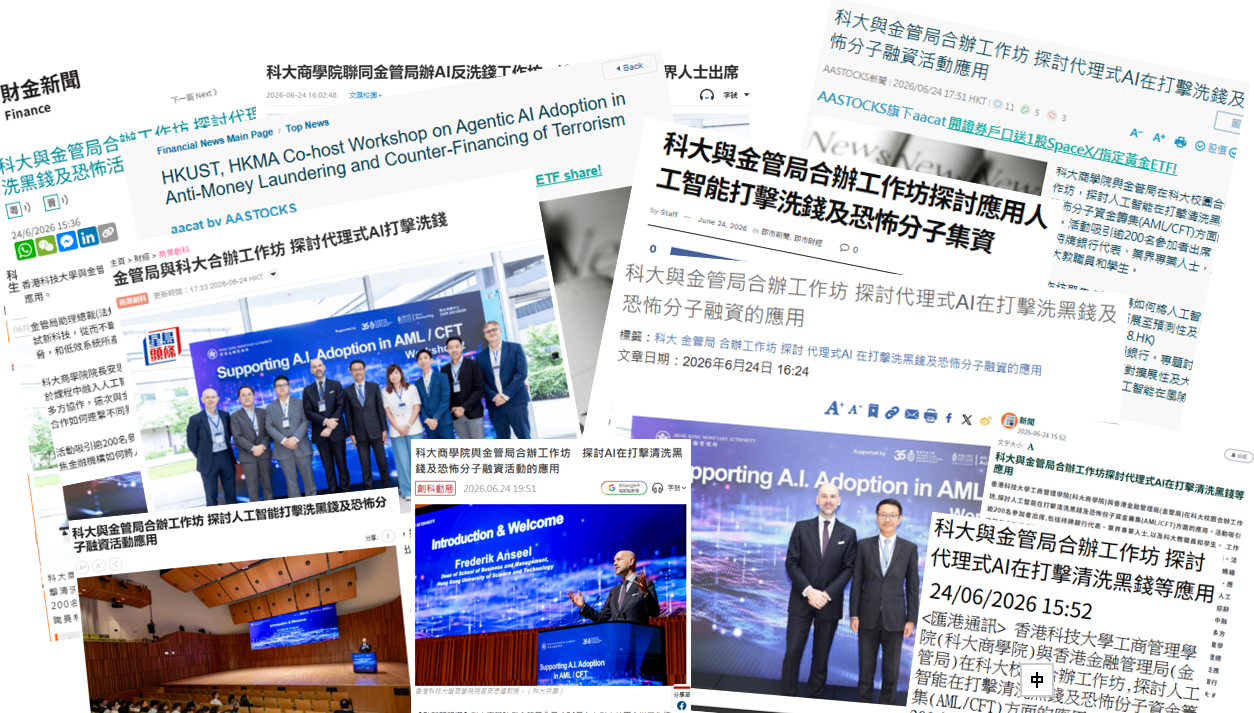
HKUST and HKMA Co-Host Workshop on Agentic AI Adoption in AML and CFT
Various media reported that the School, in partnership with the HKMA, co-hosted a workshop on AI adoption in anti-money laundering and counter-financing of terrorism (AML/CFT) at HKUST campus, drawing over 200 participants. Dean Prof. Frederik ANSEEL noted that as AI becomes a significant force driving business development, the School is integrating AI-related concepts into its curriculum to equip students with the skills needed to leverage these tools effectively
(aastocks, stheadline, Stockfisher, Hong Kong Invest, Mingpao, aastocks 2, yahoo, metroradio, infocastfnm.com, quamnet, am730, Wenweipo, on.cc, dotdotnews, HKEJ, hkcd.com, Now, infocastfn.com, quamnet, hkej, stockfisher.com, ITPRO)
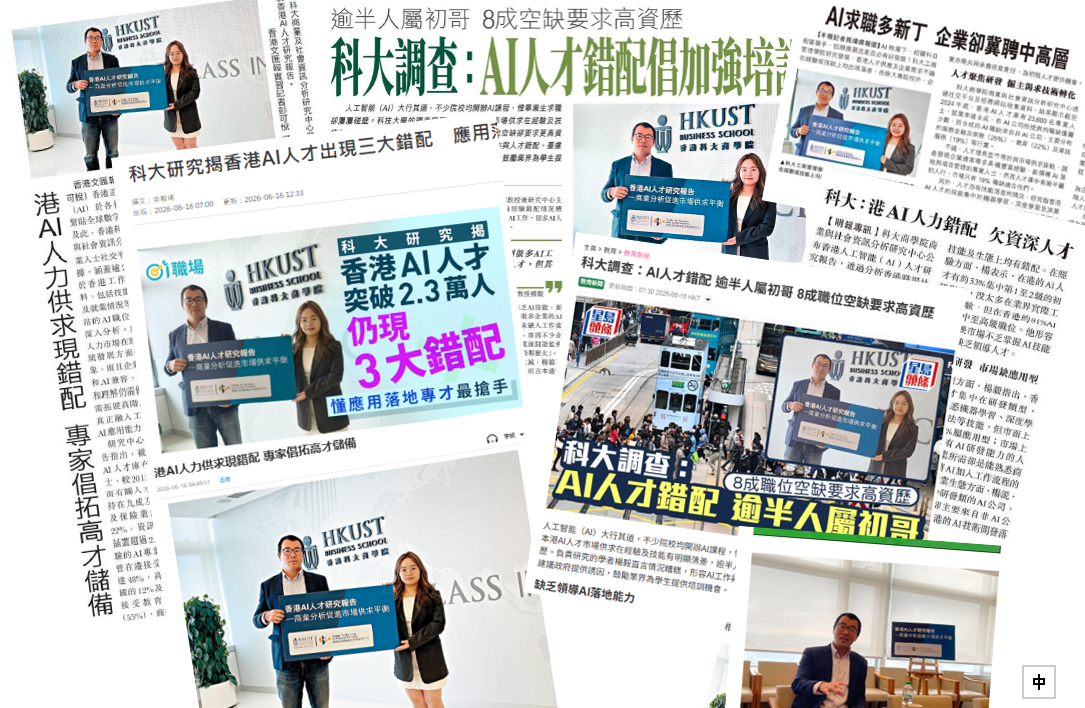
Bridging HK’s AI Workforce Gaps
According to media that include HK01, stheadline, stheadline 2, Mingpao, HKET, headline4hk.com, Wenweipo, tkww.hk, the School’s Center for Business and Social Analytics has published a report on HK's AI talent market, showing mismatches in experience and skillset. Fifty-two percent of HK’s AI talent pool consists of entry-level professionals, but a staggering 80% of open job vacancies specifically target senior- or mid-level candidates and require higher experience. Noting that HK should translate its strong AII talent base into commercial value, the center’s Director Prof. YANG Yi suggested the government to focus on attracting mid‑level and senior professionals to the city, and incentivize industries to organize more training programs.
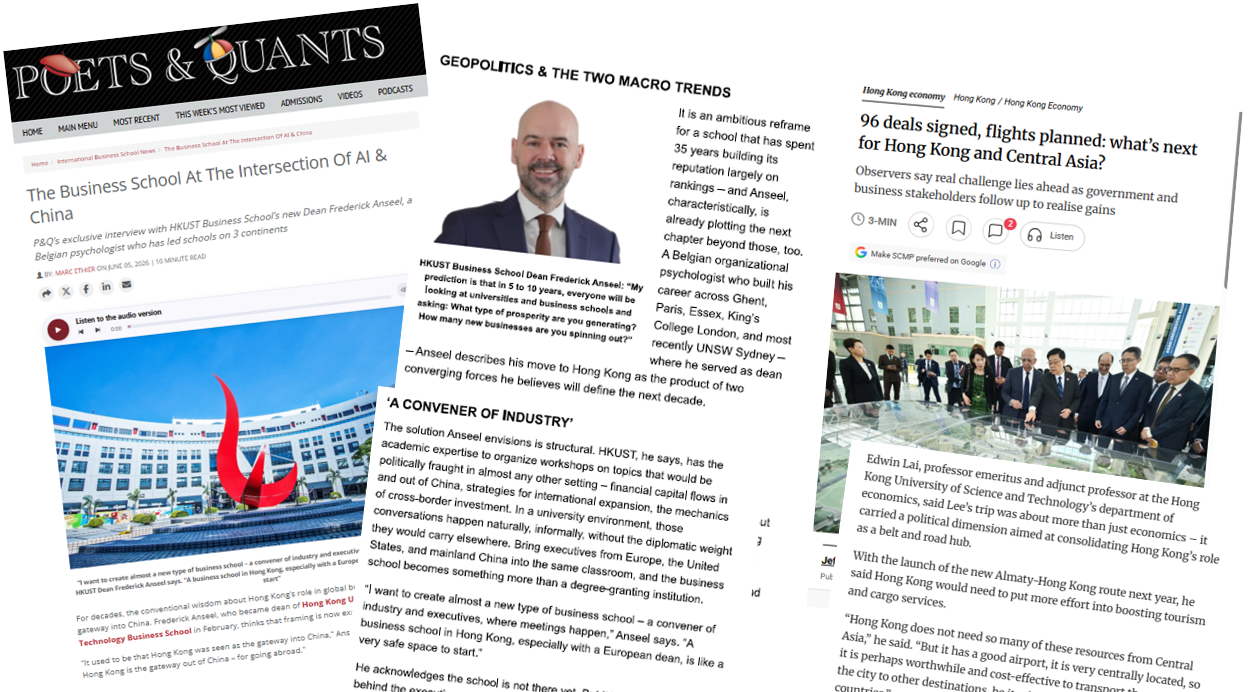
The Business School at the Intersection of AI and China
In an interview with Poets and Quants, Dean Frederik Anseel stressed that HK is no longer just a gateway into China but increasingly a gateway out for Chinese tech firms seeking global expansion. While underscoring the School’s strengths in STEM, he envisions it as a convener of industry leaders and executives, where meetings happen. His focus is on embedding AI deeply into business education and measuring the School’s success by impact rather than rankings.
HK’s Strategic Role in Central Asia
In an SCMP report, Prof. Emeritus Edwin LAI, Dept of Economics, was quoted as saying that HKSAR Chief Executive John LEE’s recent visit to Central Asia was far more than just economics - it carried a political dimension aimed at consolidating Hong Kong's role as a belt and road hub.
OTHERS
A New Path for AI Retrieval Models (Jun 29)
According to a Tech Walker report, Assoc Prof. YANG Yi, Dept of ISOM, has proposed DREAM, a training method allowing AI retrieval models to operate without manual labeling. By utilizing a frozen large language model’s "next word prediction" capability as a criterion, and combining it with attention mechanisms and candidate document competition, DREAM can learn autonomously, offering a new way to reduce AI training costs.
Expand Real-World Use of Stablecoins (Jun 30)
According to reports published in ctee.com.tw, ctee.com.tw 2, CTNEWS and CTNEWS 2, Head of HKUST Institute for Financial Research Prof. TANG Bo, while noting HK’s progressive step in allowing banks to participate in the stablecoin pilot program, called for bringing in tech firms to expand real‑world use. He also stressed the importance of HK and Shanghai working together to enhance their collective influence as digital financial centers.
Application of Virtual Identity (Jun 29)
HK Economic Journal published a column article by Assoc. Provost (Academic Development) Prof. HUI Kai-Lung on the practical application of virtual identity.
Developing Digital Finance in China (Jun 28)
Assoc. Dean of the School and Director of HKUST Institute for Financial Research Prof. LOU Dong attended the Shenzhen Xiangmihu International Finance Institute's 2026 Summer Conference. During the event, he proposed a three-step approach tapping opportunities in developing digital finance in China: establishing a compliance system, promoting Chinese blockchain standards, and creating a "bridge currency", with the goal of establishing a neutral new international financial order. (eastmoney.com, ifeng.com, thinktank.cnfin.com, sina.com.cn, 58188.com, cnr.cn).
Board’s Role in Consolidating Supply Chain Partnerships (Jun 27)
HK Economic Journal ran a column article by Assoc. Prof. ZHENG Yue, Dept of Accounting, titled "Board Relationships Consolidate Supply Chain Partnerships".
Enhancing Critical Thinking Skills (Jun 26)
An HK Economic Times column article by Prof. Allen HUANG, Head of Dept of Accounting, stressed the need to enhance critical thinking skills to avoid overreliance on AI.
Analyzing Iran’s Strengths and Weakness (Jun 26)
A Master Insight column article by Prof. Emeritus Francis LUI, Dept of Economics analyzed the strengths and weaknesses of Iran, which is gaining an upper hand in the game with the US.
Effect of AI on Education and Knowledge (Jun 22)
HK Economic Journal ran a column article by Assoc. Provost (Academic Development) Prof. HUI Kai-Lung on the impact of the rapid advancement of AI on the evolution of education and knowledge. Prof. Hui stated that the advent of the AI era has accelerated the iteration of knowledge, requiring educators to promptly restructure and reorganize what constitutes foundational education for the new era.
Strong Tourism Season Anticipated for Summer (Jun 19)
In an HK Economic Times column article, SIN Siyuan, a researcher at the Center for Business and Social Analytics, discussed the anticipated record-high visitor arrivals during the Dragon Boat Festival and summer holidays.
Disconnect between China’s Economic Growth and Stock Performance (Jun 19)
In a Master Insight column article, Prof. Emeritus Francis LUI, Dept of Economics, analyzed the disconnect between China's strong economic growth and its stock market performance relative to the US.
Future of Free Public Wi-Fi in HK (Jun 14)
In a Ming Pao Daily report on the performance of public Wi-Fi at HK’s major transport hubs, Assoc. Provost (Academic Development) Prof. HUI Kai-Lung was quoted as saying that free public WiFi should be viewed as a supplemental tool for visitors’ immediate internet needs, instead of high-bandwidth applications. Regarding the government’s new "Wi-Fi Connected City" program, Prof. Hui noted that the overarching policy goal of building long-term public internet access across the city is commendable.
Interconnected Stock Networks Yield Excess Returns (Jun 13)
Economic Digest ran a column article by Prof. YU Jialin, Dept. of Finance, on interconnected stock networks generating excess returns. Prof. Yu noted that when a specific group of leader stocks rallies, the associated laggard stocks tend to follow suit the next day. This relationship is strong enough to generate significant excess returns that far exceed traditional investment strategies.
Misinformation Risks Associated with Healthcare Products (Jun 13)
In an HK Economic Times column article, Assoc. Prof. SHI Zijun, Dept of Marketing, looked into the spread of news about healthcare products’ benefits and medical ingredients in the internet and the associated risk of misinformation.
Historical Events Offer New Ways to See Modern World (Jun 12)
According to reports by Sciencenet.cn and eastmoney, at the 9th International Conference of China and Development Studies, Visiting Prof. Wolfgang KELLER, Dept of Economics, demonstrated how the study of historical events can offer new perspectives on understanding economic transformation, institutional change, and differences in development paths.
Strategic Patience Amid Changing Geopolitical Landscape (Jun 12)
In a Master Insight column article, Prof. Emeritus Francis LUI, Dept of Economics, noted that with the US alliance system gradually disintegrating, China should maintain its strategic patience and resist adopting rigid military alliances.
Retail Investors Disadvantaged in Prediction Markets (Jun 10)
In news reports published in Sing Tao Headline.com and Eastweek Web about prediction markets, Assoc. Provost (Academic Development), Prof. HUI Kai-Lung was quoted as saying that small retail investors frequently fall prey to large investors due to information asymmetry. As some projects lack sufficient information for analysis, large-scale operators often leverage insider knowledge to anticipate or manipulate outcomes. However, Prof. Hui believed that utilizing transparent blockchain ledgers can assist authorities in tracking illegal activities.
Regulating the Stablecoin Market (Jun 8)
In an HK Economic Journal column article, Assoc. Provost (Academic Development) Prof. HUI Kai-Lung analyzed the issuance of ride-hailing licenses and their detachment from market fees. Separately, in a discussion featured in HK Economic Journal video channel (facebook.com, facebook 2), Prof. Hui noted that stablecoins offer superior efficiency for institutional settlements but are barely used by the general public. He added that the stablecoin market is now in a pilot stage, and stringent regulations are reasonable but limit the room for I&T startups to grow up.
Media Formats Shape Advertising Outcome (Jun 6)
An HK Economic Journal column article by Assoc. Prof. LIN Song, Dept of Marketing, delved into the importance of media format in successful advertising, exploring how three distinct media formats – static advertising, sequential advertising and interactive advertising – manage consumer attention, navigate misaligned incentives, and impact user welfare.
How Receiving Help Influences Creativity (Jun 6)
An HK Economic Times column article by Prof. GONG Yaping, Head of Dept. of Management, discussed the effects of receiving dependent and autonomous help on subsequent creativity.
US-China Dynamics Affect Potential Cross-strait Unification (Jun 5)
In a Master Insight column article, Prof. Emeritus Francis LUI, Dept of Economics, examined the changing US-China dynamics and their impact on the potential cross-strait unification. He remarked that the subtle shifts in US-China relations are advantageous to China’s unification.
AI Value Lies in Applications (Jun 1)
HK Economic Journal ran an article by Assoc. Provost (Academic Development) Prof. HUI Kai-Lung discussing the Artificial Intelligence Index Report 2026 issued by the Stanford Institute for Human-Centered Artificial Intelligence. While the global AI market is heavily obsessed with comparing the raw performance of large models, Prof. Hui argued that chasing minor baseline score differences yields little practical value.