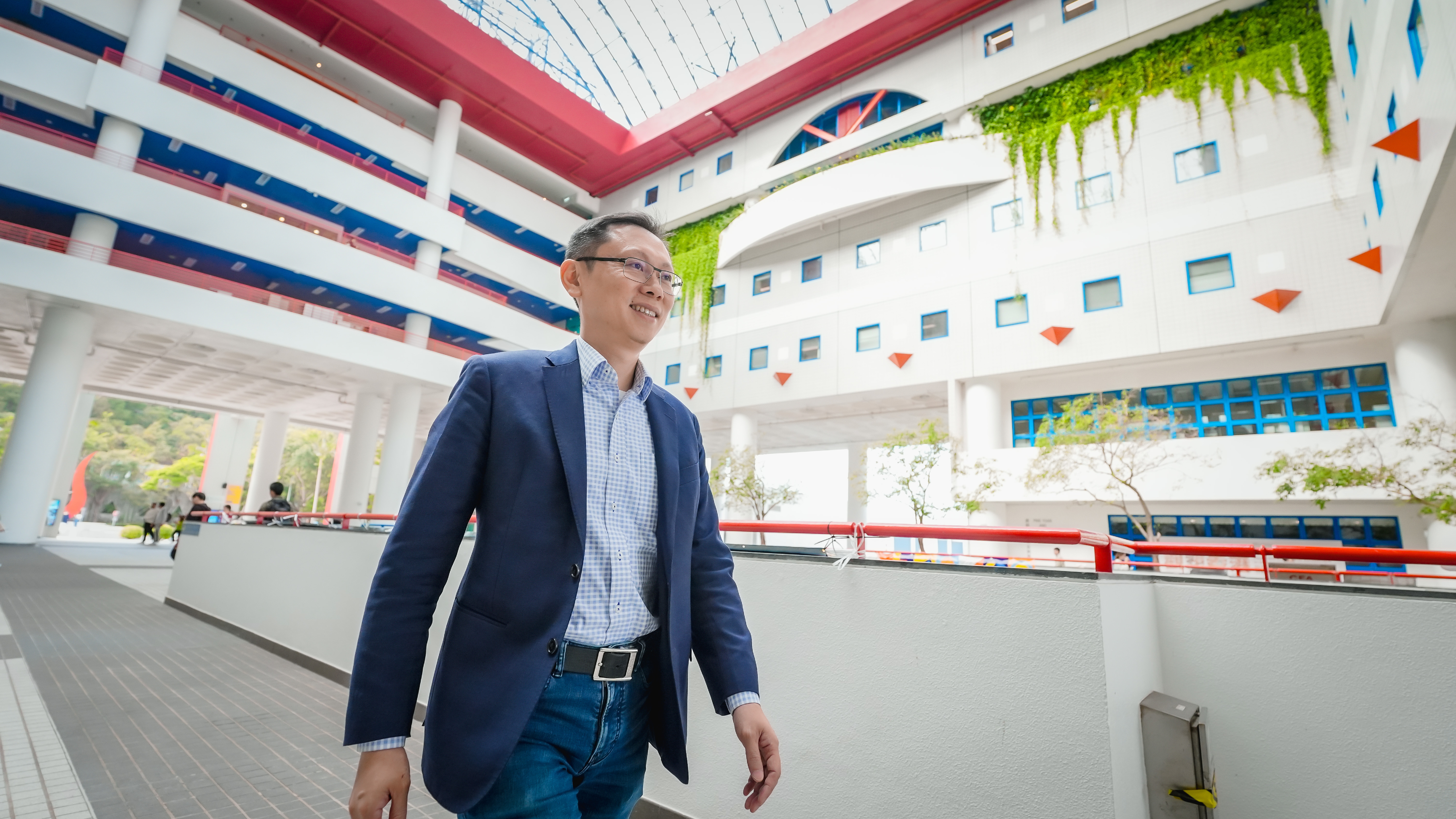
Professor HUI Kai-Lung, Associate Provost (Academic Development) at HKUST (HKUST BBA and PhD Graduate), reflects on his unique path from pioneer undergraduate to academic leader—growing alongside the university he has called home for more than 30 years.
When Professor Hui Kai-Lung first arrived at HKUST in 1993, the red brick paths were still settling, the campus was expanding, and the University itself was little more than an ambitious experiment. As a member of HKUST’s third cohort of undergraduates, he chose the young institution not for its reputation, but for its promise.
More than three decades later, having served in key leadership roles—including a recent term as Acting Dean of the HKUST Business School — Professor Hui reflects on his own journey mirroring HKUST’s evolution as the University marks its 35th anniversary.
A Beginning Shaped by Freedom and Possibility
Professor Hui recalls HKUST’s early years as a time defined by openness. “Everything was still being built,” he reflects. “There were no rigid structures holding anyone back.” Students were encouraged to explore, create initiatives, and pursue unconventional ideas. Professors taught with an informality rare in traditional institutions.
Students didn’t sit across from professors—they sat beside them. “There was a sense that we were creating something together,” Professor Hui says. This culture of co-creation would become, in his view, a hallmark of HKUST’s identity and a formative experience for alumni who grew alongside the institution.
An Exchange That Opened His World
A pivotal moment came when Professor Hui spent a semester on exchange at the University of Pennsylvania. For a young Hong Kong student, it was his first immersion in a globally diverse academic setting. “It was eye opening,” he says. “You meet people from everywhere and understand how diverse the world really is.”
The experience also confirmed something important: the standard of education he encountered abroad felt closely aligned with what he had at HKUST. That realization affirmed that the young university he had taken a chance on was already competitive with established global institutions.
Surrounded by peers aspiring to academic careers, Professor Hui began to imagine a path he had not previously considered—becoming a professor. This seed, planted during the exchange, would guide the next phases of his life.
A City and School He Believed In
After completing his doctorate and spending several years at the National University of Singapore, Professor Hui felt drawn back to Hong Kong. Its pace, energy, and culture of constant renewal resonated with him. Equally appealing was the opportunity to join HKUST Business School, where information systems thrived at the intersection of technology, business, and society.
“In a business school,” he explains, “you can study problems that are academically interesting and immediately relevant to the world.” HKUST offered the freedom and intellectual space to pursue emerging topics such as privacy, cybersecurity, and data governance long before they became mainstream concerns.
The Privilege of Academia
Professor Hui often credits his mentors—especially Professor TAM Kar-Yan, his supervisor—for shaping his academic philosophy. Professor Tam returned from the US not to join a well established institution but to build one. “With that kind of spirit, I would call him a settler,” Professor Hui says. “You’re coming here to settle this place, to expand this place.” It was a mindset that influenced Professor Hui’s own approach to leadership: “Very often it is not what we can accomplish that matters, but what we hope to accomplish—our ultimate vision.”
He describes academia as a profound privilege. “Being a professor, we enjoy our freedom. You really can choose to do what you want.” This autonomy enabled Professor Hui to pursue forward looking research into digital issues that would later become central to global policy and business.
One value has anchored his entire career: an unwavering commitment to quality. “We always look for the best. We don’t settle on the inferior path.” His advice to students reflects this ethos: focus on doing your current work well. “When I settle on a task, I will want to make sure I do it at the best.”
Looking Ahead
As HKUST celebrates its 35th anniversary, Professor Hui sees an institution that has matured significantly while preserving the spirit that defined its early years. It is more structured and professional today, he notes, “but still very much vision driven,” maintaining the boldness and curiosity that shaped its first generations of alumni.
Looking ahead, he is steadfast in his belief that HKUST will be successful at what it has always aimed to do: nurture people who will build not only for today, but for the decades to come.
“We’ve benefited from the environment our predecessors set for us,” he says. “Now, we need to think about who will be our future beneficiaries.”