


HKUST Business School released findings from a city-wide survey study, AI in the Workplace: Perceptions and Preparedness of Workers, exploring workers’ experiences and perspectives on workplace AI adoption.
The survey examines AI awareness and usage, perceived impacts on work and careers, attitudes towards adoption and regulation, workforce preparedness and training needs, and organizational support and governance.The findings were presented by Prof. TAM Kar-Yan, Vice-President for Administration and Business and Chair Professor of Information Systems, Business Statistics and Operations Management, at a press event that also featured recent HKUST graduates sharing their experiences across different industries.
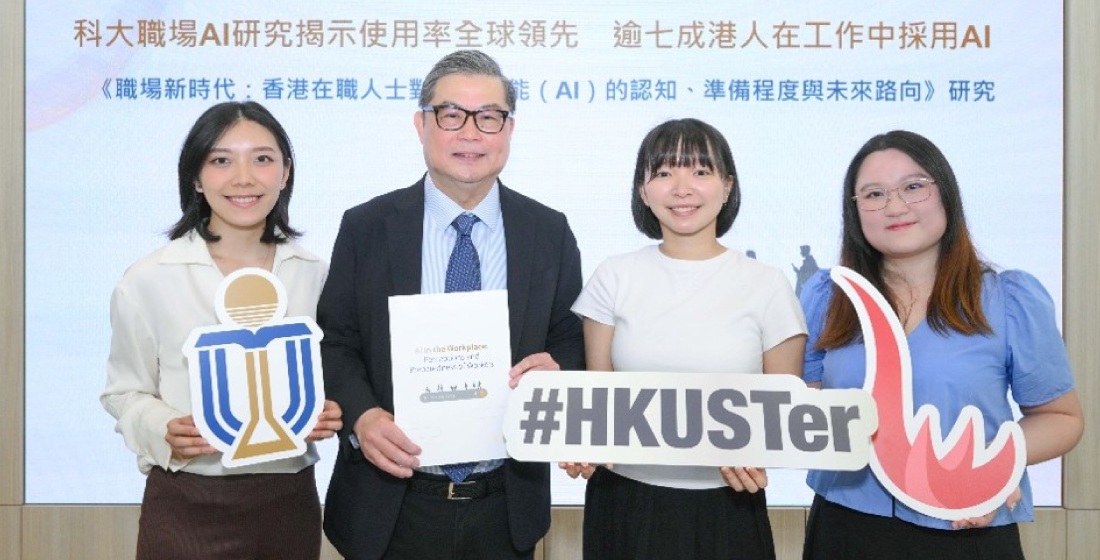 Bringing findings to life: recent HKUST graduates Agnes LAM (left), Audrey CHAN (second right), and Niki HO (right) share how AI supports their work in education, retail and business development.
Conducted between March and April 2026, the study gathered 3,722 valid responses from workers spanning a wide range of industries, occupations, job levels, and company sizes. The results show that workplace AI adoption is widespread in Hong Kong, with 72.7% of respondents using AI daily or several times a week—significantly above the 31% global average reported in KPMG’s 2025 study*. Despite this high level of adoption and strong interest in upskilling, notable gaps remain in organizational readiness, employee training and practical AI capabilities.
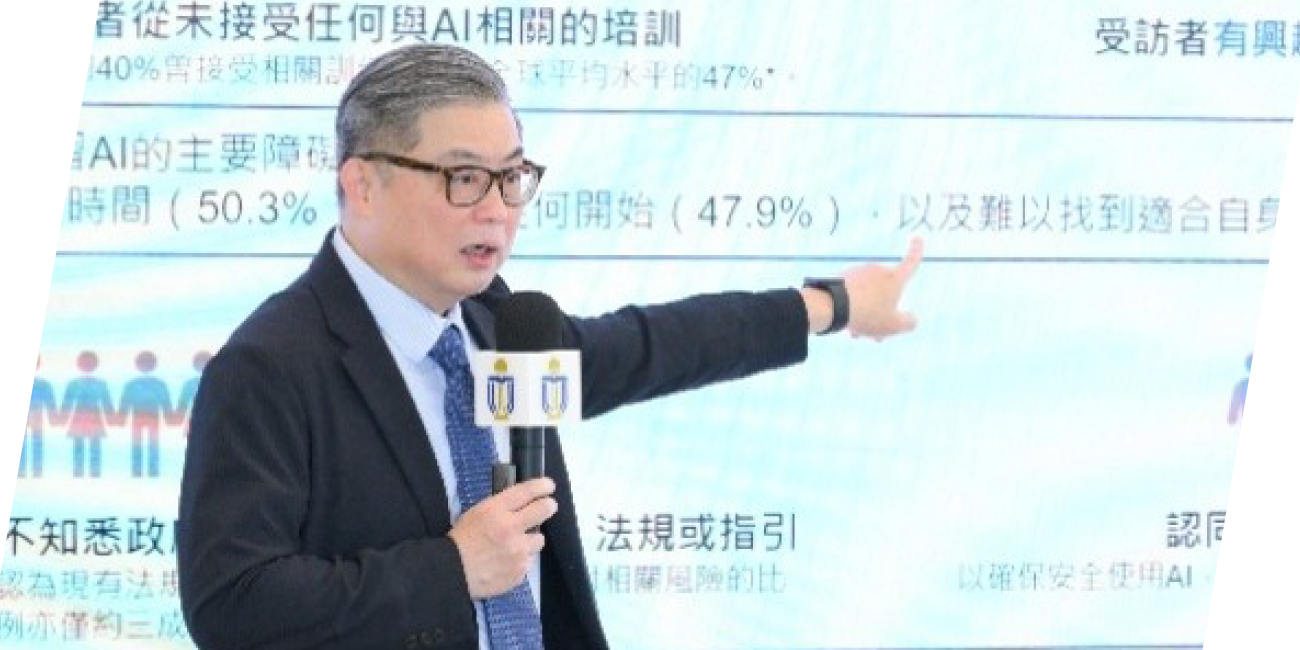
Key trends fromthe study include:
- Organizational AI adoption continues to lag behind employee use. While workplace AI use is widespread, only around a quarter of respondents said their organizations were scaling AI deployment or had fully integrated it into operations. Fewer than 30% reported having formal AI-related policies or governance measures.
- AI use remains relatively limited in scope. Usage is largely concentrated on generative AI tools (82%) and free public platforms (72%), rather than employer-provided solutions.
- Workers are optimistic but cautious. Nearly 80% reported positive impacts on their work. However, almost half expressed concern that AI could devalue their skills, while around 40% believe it had weakened their sense of job security. These concerns are particularly pronounced among junior workers.
- The AI skills and training gap remains significant. Although more than 70% of respondents are interested in developing AI-related skills, nearly 60% have never received AI-related training.
The findings point to a clear next step: the next phase of AI transformation must move beyond increasing usage to closing individual and organizational readiness gaps, embedding AI more deeply into end-to-end workflows, and supporting an inclusive transition through coordinated action by employers, educators, policymakers, and workers. Learn more about the study.
*KPMG (2025). Trust, attitudes and use of Artificial Intelligence: A global study 2025