An analysis of more than 60,000 Kickstarter projects finds that older creators often secure more funding than younger ones.
Authored by Sang Kyu PARK, FANG Lu, and Anirban MUKHOPADHYAY
Age may just be a number — but research on ageism shows that that number can come with some serious costs. Studies have found that older workers experience a wide range of age-based discrimination, from assumptions that they are less technologically savvy to perceptions that they’re less adaptable or open to feedback.
That said, much of this prior research focuses on traditional employment contexts. How might older workers’ experiences evolve as alternative forms of work, such as selling directly to consumers on platforms like Kickstarter, or engaging in gig work on platforms like Upwork, grow increasingly popular?
On the one hand, the same biases that older workers face in other contexts likely remain in effect. On the other hand, buyers on consumer-to-consumer (C2C) platforms must make decisions based on very different information than employers and customers in traditional, more standardized environments, suggesting that workers in these settings might experience substantially different outcomes.
To explore these effects, we started by conducting a large-scale analysis of data from the crowdfunding platform Kickstarter. We collected project descriptions, creator profile photos, and funding outcomes from 62,000 Kickstarter projects launched in 2021, and then used facial recognition algorithms to estimate each creator’s age and attractiveness from their photo. (We measured attractiveness because prior research has shown that all else being equal, physical attractiveness often has a major impact on funding outcomes.)
Older Creators Raise More Money
Through this analysis, we identified a strikingly consistent pattern: Controlling for attractiveness, older creators actually raised more money and attracted more backers than younger creators did. Even when we also controlled for gender, race, facial expressions, perceived intelligence, project category, funding goal, campaign length, and the quality of the project description, the effect remained. The only time the effect disappeared was among creators rated as extremely unattractive: For extremely unattractive creators, age was not associated with funding success. But for the vast majority of creators, we found that projects launched by older people consistently secured more backers, raised more money, hit higher percentages of their funding goals, and were more likely to meet their funding goals.
What drove this surprising effect? To find out, we ran two follow-up experiments with more than 300 participants from around the world.
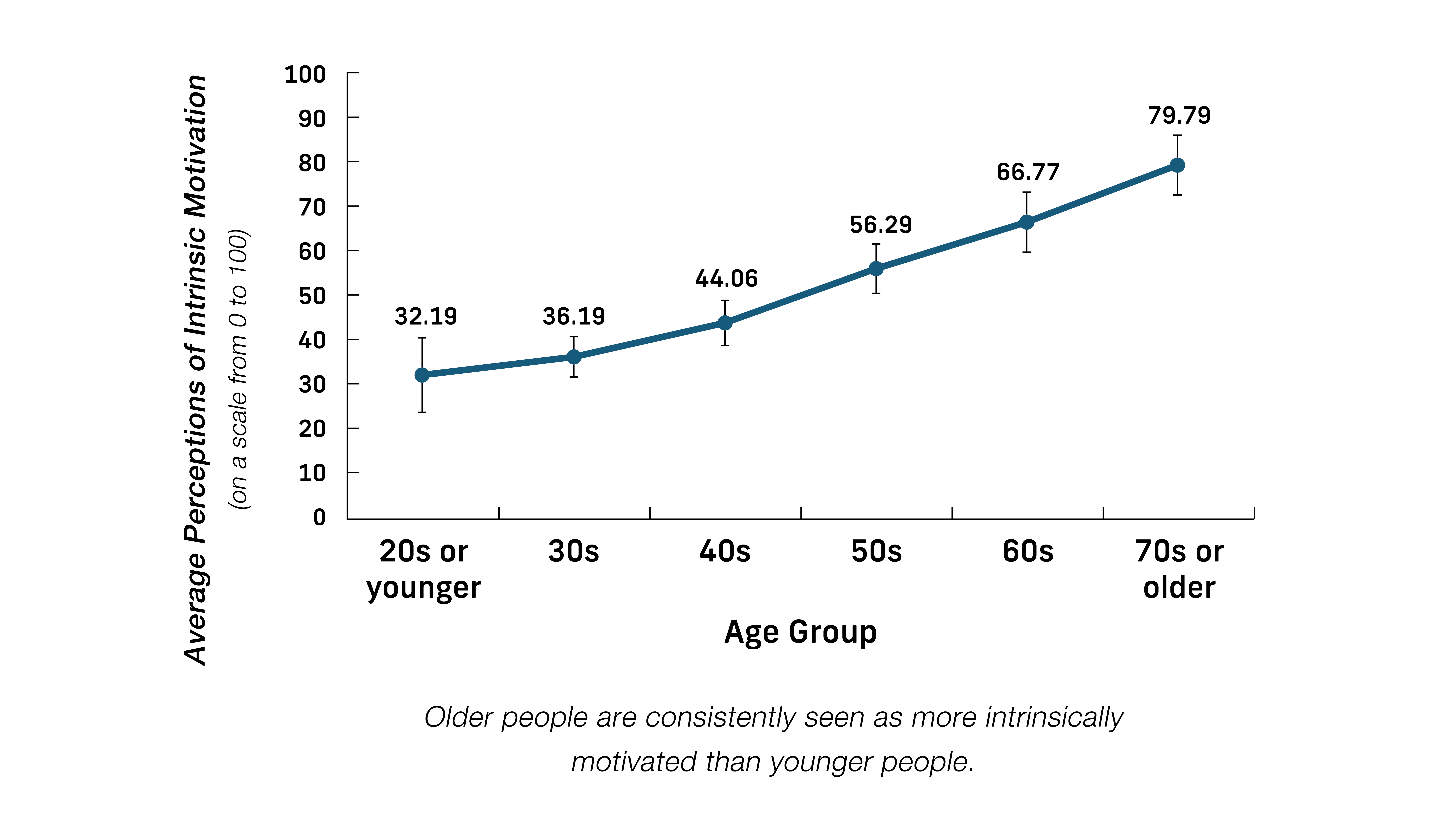
In the first experiment, we showed people a set of profile photos from the Kickstarter dataset and asked them how old they thought each creator was, how willing they would be to back their project, and whether each creator seemed genuinely interested in the project or primarily motivated by earning money. Again, we found that people were more willing to fund older creators’ projects — and we found that the reason boiled down to people’s perceptions of the creators’ motivation. On average, our participants were more likely to assume that the older creators were pursuing these projects because they genuinely cared about the work, and as a result, the participants were more likely to be willing to fund them.
Older Workers Are Seen As More Intrinsically Motivated
Next, in our second experiment, we showed participants similar photos but told them that these were individuals who had recently joined a gig work platform that connects people with short-term jobs, such as providing voiceovers for audiobooks and animations or offering online tutoring. And here, too, we found the same effect: Except for photos rated as extremely unattractive, participants reported that they would be more willing to hire older workers than younger ones, and the underlying reason for this was that they assumed that the older workers were more intrinsically motivated.
Interestingly, there is good reason to think that people aren’t wrong in making this assumption. Research has shown that indeed, as we age, our priorities tend to shift toward activities that feel personally meaningful rather than financially rewarding. In other words, the people in our studies may generally have been correct in their intuition that the older creators and gig workers were more intrinsically motivated than their younger counterparts. However, the fact that people make this assumption based on age alone — and that this assumption, in turn, drives funding outcomes and hiring decisions — suggests that alongside the many well-publicized downsides of aging, in C2C contexts, older workers may actually have a competitive edge. This informs several practical implications, both for platforms and for the people selling on them.
1.Platforms: Don’t Overlook Older Sellers
Because the challenges associated with ageism are so well-established, C2C businesses may assume that it’s not worth their time to encourage older sellers to join their platforms. However, our research demonstrates that to the contrary, older people may actually have better outcomes on these platforms. As such, rather than treating age as irrelevant or assuming that older sellers are at a disadvantage, platforms could consider giving these users greater visibility. After all, our findings suggest that consumers often think older sellers are more intrinsically motivated, which can make them more willing to hire them or support their projects.
The one caveat here is that age was no longer associated with funding success among people with photos rated as extremely unattractive. This suggests that platforms can help sellers avoid poor first impressions by offering simple tips on lighting, framing, and photo selection. Importantly, our research shows that it’s not necessary to be particularly attractive, or adhere to some narrow standard of beauty. Even marginally unattractive creators experienced the positive outcomes associated with age — so, with a bit of basic guidance, platforms can likely help many people keep low-quality or unflattering photos from tainting otherwise positive impressions.
2. Workers: Don’t Let Age Hold You Back
Similarly, many older workers may (understandably) assume that ageism could hinder their success on C2C platforms. But while biases against older workers are indeed a barrier in many traditional employment contexts, our research shows that age can actually be an advantage in C2C environments. As such, older sellers shouldn’t let fears that they’re “too old” hold them back from trying to participate in these new markets.
3.Younger Workers: Highlight Your Intrinsic Motivation
Finally, while our research illuminates a bias that can impede younger workers, it also offers the means by which they can mitigate that bias. Buyers may assume that younger workers aren’t as intrinsically motivated, and that assumption can make them less likely to hire young people or fund their projects. But in a supplementary study, we found that when younger people explicitly stated a genuine interest in their work, it increased consumers’ willingness to hire them, substantially narrowing the gap between younger and older workers. In other words, if your age means that you won’t automatically benefit from the assumption that you’re intrinsically motivated, you can still bridge that gap by communicating your motivation directly.
To be sure, our research does not negate the many challenges that older workers face, or suggest that older C2C workers will always benefit from heightened perceptions of intrinsic motivation. In particular, in our Kickstarter data, age was more strongly associated with the amount of money raised and the number of backers than with whether a campaign met its funding goal, implying that older creators may have a greater advantage on platforms where each additional transaction, booking, or dollar contributes directly to their success. Similarly, while we found this pattern across a range of C2C markets, it is possible that the magnitude of the effect may vary depending on the specific platform or type of work.
But in a world where age is so often a disadvantage, our findings offer a refreshingly optimistic perspective — a silver lining, as it were: In C2C markets, older sellers are seen as more genuinely invested in their work and, as a result, more worthy of support. As such, sellers and platforms alike should recognize that the C2C economy has room for us all: young, old, and everyone in between.
Sang Kyu PARK is an assistant professor of marketing at HKUST, focusing on decision confidence, inference-making, online consumer behavior and new technology.
FANG Lu received her Ph.D. at HKUST specializing in consumer behavior and is now an associate professor at the University of Science and Technology of China.
Anirban MUKHOPADHYAY was previously a chair professor of marketing at HKUST, and is now a professor of marketing and behavioral science at City St. George's University of London, with research focusing on the interplay between consumers’ lay beliefs, emotions, and self-regulatory decisions.
This article draws on the research paper “Effects of Age and Attractiveness of C2C Providers on Commercial Outcomes,” authored by Fang Lu, Anirban Mukhopadhyay, and Sang Kyu Park.