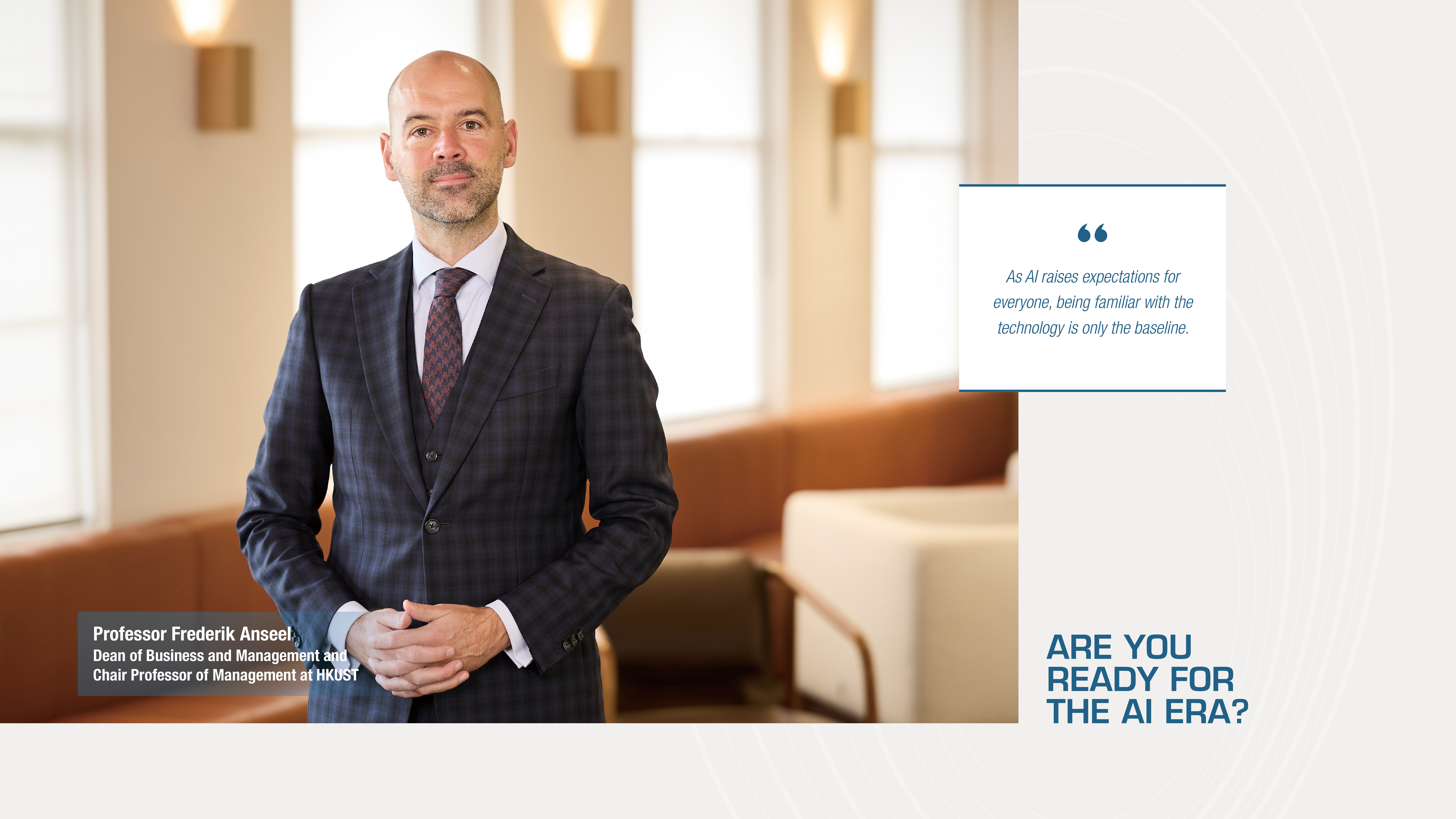
AI is changing the landscape of business and education, creating new opportunities as well as challenges. Drawing on his expertise in organizational behavior, leadership, and the future of work, HKUST Business School Dean Professor Frederik ANSEEL discusses how organizations, business schools, and individuals can prepare for the changes ahead.
China and the United States are widely regarded as global leaders in AI. How do their approaches to AI adoption differ?
Anseel: Global AI is developing along distinct U.S. and Chinese paths.
The U.S. focuses on frontier models, with firms competing around chips, infrastructure. Its use is often individual, giving employees in knowledge-based sectors tools to raise personal productivity.
China is more focused on embedding AI across manufacturing and production lines. This offers productivity and innovation at scale, especially through automation and robotics, but requires safety, reliability, and close coordination.
The Western challenge is scalability: productivity may improve at the individual level, but transformation is limited if use remains fragmented. Today, the holy grail for Western firms adopting AI is turning individual productivity gains into firm productivity growth. In China, policymakers are pushing AI across industrial value chains. The costs are high, but the potential gains are significant.
This shows that AI transformation is not just technological; it also requires management capability to redesign work, scale skills, and engage employees. Management education can therefore play an important role.
Should business schools embed AI across curricula or launch standalone AI-business degrees?
Anseel: It has to be both. What I want to avoid is simply adding “AI” to existing offerings as a superficial relabeling exercise.
Rather than treating AI as a standalone topic, we are looking at how it may be incorporated where appropriate across the curriculum. As part of this process, we are reviewing all of our courses, considering emerging skills needs, and helping students and faculty adapt to a changing landscape. Redesigning courses is not only about introducing AI, but also anticipating how uniquely human skills will become more important.
At the same time, we need focused offerings. In executive education, for example, our technology management program brings Chinese technology executives and founders together to examine emerging technologies, business models, and investment needs. In our master’s programs, we also emphasize technology entrepreneurship and innovation.
Any AI-focused courses should serve a global market while reflecting Asian and Chinese characteristics—one of our unique strengths—by combining global cases with regional examples.
In an AI-driven job market, how can young people stay relevant, build a distinctive edge, and seize opportunities?
Anseel: For young people, this may be the best possible time. There is this famous technology quote from Douglas ADAMS: “Anything that is in the world when you’re born is normal and just a natural part of the way the world works. Anything that's invented between when you’re fifteen and thirty-five is new and exciting and you can get a career in it. Anything invented after you're thirty-five is against the natural order of things”. So, for current students, AI is already their new normal and if they stay current with new models so many exciting opportunities will present themselves.
At the same time, they need a clear point of differentiation. Let’s assume that industry will now require that everyone has similar AI capabilities. That is the new normal. Students should then ask what specific skill, industry, or question they can understand more deeply than others. That may mean looking beyond mainstream areas. Innovation often comes from the periphery, and niche expertise can become highly valuable.
For example, a student who combines AI fluency with deep knowledge of healthcare innovation, or other emerging fields could stand out to private equity, investment management, or consulting firms.
As AI raises expectations for everyone, being familiar with the technology is only the baseline. The real advantage comes from combining AI capability with distinctive deep expertise that gives a person comparative advantage in areas others have not yet mastered.
What are the greatest organizational and psychological challenges leaders face during AI transformation?
Anseel: The biggest challenge is trust—both in people and in technology.
On the people side, employees worry about what AI means for their future, including possible job displacement. Leaders need to be transparent about why AI is being adopted, what changes are taking place, and how employees fit into the organization’s future.
They also need a long-term view. AI can deliver short-term efficiency gains, and it may be tempting to pause hiring to exploit those initial efficiency gains, but organizations must still build the talent pipeline needed for future growth.
What matters is not only what organizations do with AI, but how employees interpret those actions. When people see AI as a tool to help them work more effectively, they are more receptive. When they see it as a way to monitor, control, or replace them, anxiety and resistance grow.
Successful AI strategies should therefore focus on augmentation of people’s skills rather than replacement. Leaders must help employees understand the transformation, invest in skills development, and show how AI can support human potential rather than undermine it. There is an important role here for governments to develop broad AI strategies that will benefit all and not just a small group of lucky ones.
What are some common misconceptions business managers have about AI adoption?
Anseel: A common misconception is that anything AI can do is worth doing with AI. When adoption becomes unfocused, organizations may generate a great deal of activity without creating much real value.
Early experimentation was useful, but companies now need to move beyond the “Wild West” stage of AI adoption. Leaders must set clearer priorities: where AI can solve meaningful problems, where investment is justified, and where caution is needed. They need to identify problems where AI can make a meaningful difference, and which activities should remain human-led.
What about trust in technology, the AI system itself?
Anseel: Trust in technology is equally important. Even occasional AI failures can make people reluctant to rely on it, so organizations must ensure systems are reliable, transparent, and suited to their tasks.
A key challenge is that people often judge machine decisions differently from human ones. Even when AI performs well, many still prefer human judgment in situations involving human relationships, communication, or sensitive decisions.
Trust in machines is not automatic. As organizations become more digital, preserving human connections becomes more important.
For leaders, the challenge is to create an environment where people feel comfortable using AI. That requires clear guidelines, appropriate human oversight, and technology that strengthens rather than replaces authentic human interactions.
Ultimately, successful AI adoption depends on balancing technological capability with human judgment. Organizations that preserve trust, transparency, and humanity will be far better placed to realize AI’s benefits.
What does it take for organizations to translate AI’s technical potential into sustained productivity gains?
Anseel: To translate AI’s technical potential into sustained productivity gains, leaders must rethink workflows, identify where people add the most value, and ensure human expertise complements AI-enabled work.
Most jobs involve interconnected tasks. Even when AI automates some of them, the overall process can still be slowed by human judgment, coordination, and decision-making.
The real breakthrough comes from redesigning workflows, not simply automating isolated tasks. Humans should focus on judgment, creativity, relationships, negotiation, and leadership, while AI takes on work that can be reliably automated.
The history of electrification offers a useful parallel. Early factories first replaced steam engines with electric motors, but major productivity gains came only when layouts and workflows were redesigned around electricity. AI is similar: adding it to existing processes will deliver limited gains unless work itself is reorganized.