


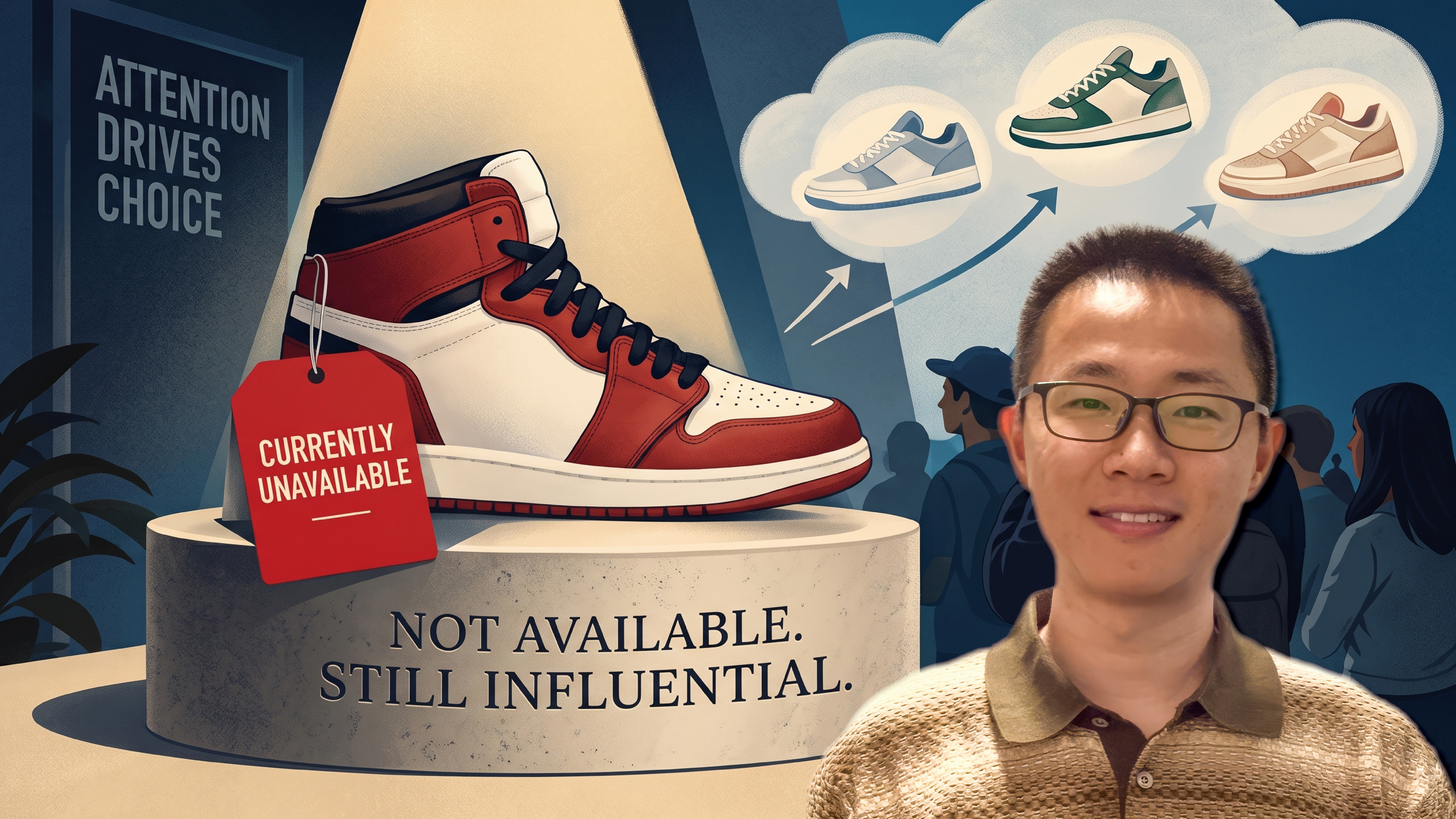
Products that are sold out, not yet released, or otherwise unavailable can still have a major influence on what customers ultimately choose to buy.
Authored by TANG Rui
When it comes to sales and marketing, most brands focus their efforts on the products their customers can buy today. And that’s a reasonable enough approach. Brands are, after all, in the business of selling products. But the products that are available for purchase today are not in fact the only ones that matter: Whether a product is sold out, not yet released, unavailable in a local market, prohibitively expensive, or otherwise restricted, there are many reasons why customers might see products that are not currently available to them — and our new research shows that even if they can’t buy those products, just seeing them can have a substantial impact on what they do choose to buy.
Specifically, we model how consumers’ attention can move from one product to the next: When a customer notices one product, it can remind them of another product, which may in turn remind them of yet another. The product they end up buying may not seem related at all to the product that first attracted their attention, and that initial product may not have even been available for purchase, and yet it played a vital role in their buying journey.
In other words, when it comes to purchasing decisions, there are two critical factors to consider. The first is preference: If a consumer thinks about several products, which do they like more? This is what most marketers focus on. But the second is just as essential: attention. Which products enter the customer’s mind at all?
A product may sell poorly because consumers dislike it, but it may also sell poorly because very few consumers ever think about it. Another may sell well not only because buyers like it, but because they notice that it’s an option — and a product doesn’t have to be available to attract attention that can ultimately lead customers to another offering. For example, seeing a sold-out iPhone model may lead a customer to buy another product from Apple. Seeing a limited-edition watch may push someone to buy a mass market alternative. Awareness of an expensive product that most consumers will never purchase may still affect how they evaluate cheaper alternatives.
Importantly, these effects can benefit a brand, but they can also work against it. If a customer visits a website because of a heavily promoted product that is already sold out, explores the brand, and ultimately buys something else from them, the company still wins. Conversely, if a brand attracts customers’ attention only to remind them of a competitor, the original company loses out.
As search engines, recommendation systems, social media, and AI agents make it easier and easier for customers to learn about different products, it becomes more and more likely that they will be shown products that they cannot immediately buy. As such, it is increasingly urgent for brands to incorporate customers’ associations with these visible yet unavailable products into their marketing strategies. Specifically, our research highlights five key strategies for brands:
1.Determine the Impact of Unavailable Products on Your Customers’ Buying Behavior
Most companies collect enormous amounts of information about clicks, purchases, searches, and abandoned carts, but they often pay much less attention to products that customers saw but could not choose. Was a product visible but sold out? Did a user see an item that was unavailable in their region? Was a recommendation displayed even though the recommended product could not be delivered? Did a customer encounter a premium product before buying a cheaper one?
Questions like these carry important implications for how purchases actually get made. As such, rather than discarding data about unavailable products, marketers should proactively track how customers engage with these products, and quantify their impact on buying behavior alongside traditional metrics.
2.When Associations Benefit Your Brand, Build an Attention Funnel
Once you’ve determined whether associations with unavailable products help or harm your brand, you can begin to optimize your strategy accordingly. When these associations benefit your brand, you can leverage those positive associations by building an attention funnel that pulls buyers toward your other offerings.
For example, Popmart intentionally releases limited editions of its flagship Labubu product, ensuring that these highly sought-after products are frequently visible but sold out. Despite these “phantom” Labubu figures being unavailable for purchase, Popmart features them prominently across their social media and physical store displays, using them to attract attention that it then funnels away from competitors and toward other, available Popmart products.
3.When Associations Harm Your Brand, Build a Walled Garden
Conversely, when associations with other products harm your brand, you can protect your customer base by building a walled garden that severs those associations. That means ensuring that when customers see your products, they are reminded only of other products sold by your brand — not of your competitors.
A customer on the market for a vacuum cleaner, for instance, may see an advertisement that initially attracts their attention to Dyson. But if learning about Dyson then reminds them of Shark’s budget alternatives, they might be more inclined to choose the cheaper, “good enough” option. As a result, Dyson would pay doubly: First they would pay the advertising cost of initially attracting the customer, and then they would pay the cost of ultimately losing that customer to a competitor.
To address this, Dyson can intentionally weaken the mental associations between their brand and cheaper, functionally similar competitors. Investing in distinctive product design, luxury branding, and marketing messaging that avoids direct functional comparisons can help Dyson ensure that buyers who are initially attracted to Dyson do not have their attention diverted to competing brands.
4.If You Manage a Platform, Build Associations Intentionally
Associations between products impact many brands, but they are particularly relevant to platform firms, as these businesses are able to take direct action in building associations between the products offered on their platforms. From “customers also viewed” lists to sponsored placements, suggested product bundles, and other design choices, platforms can intentionally redirect customers’ attention — including providing alternatives when initially-considered products are out of stock, members-only, or otherwise unavailable.
This becomes especially important for platforms like Amazon that sell both their own products and third-party offerings. On the one hand, Amazon can add value to the sellers on its platform by leveraging product associations in ways that benefit them. On the other hand, Amazon can also choose to build associations that funnel customers toward their own offerings, or wall customers off from third-party competitors. While there is no simple solution to this optimization problem, platforms should make these choices intentionally, thinking strategically about how they direct customers’ attention rather than ignoring the impact of visible but unavailable products.
5.Experiment and Iterate
Most importantly, by tracking how unavailable products influence consumers’ attention and downstream purchasing behavior, brands can start to experiment, iterate, and optimize these associative links. A retailer could compare customers who see a sold-out product with similar customers who do not, and examine how that difference correlates with demand for other products. A platform could study whether showing a recommendation for an unavailable option raises or lowers demand elsewhere. Firms could experiment with placing products together, separating them, or changing which unavailable products remain visible.
Companies can then use this data to construct an association map showing which products tend to bring which other products to mind. While a conventional substitution map simply tracks products that are similar enough to substitute for one another, an association map captures the more nuanced ways in which products can be associated with one another. Indeed, two products can be close substitutes without strongly reminding consumers of one another, while two quite different products may be closely associated because of overlap in branding, usage, advertising, or previous experience.
Most firms focus most of their sales and marketing efforts on managing prices, advertising, and distribution for the products that are available for customers to buy. But our research emphasizes that the mental links between their offerings and other products that consumers are exposed to (even if they are unable to buy those products) may also be worthy of managers’ attention.
As such, rather than ignoring information about unavailable products, or assuming that these products are irrelevant, brands should recognize that products don’t have to be immediately available for purchase to be important parts of their customers’ journeys. To the contrary, unavailable products can still carry powerful associations with other products. It’s up to brands to manage those associations intentionally — whether that means building them up, severing them, or leveraging them strategically to steer customers’ attention in the right direction.
TANG Rui is an associate professor of economics at HKUST, with research interests in decision theory, behavioral economics, and health economics.
This article draws on the research paper “Associative Networks in Decision Making,” authored by LI Jiangtao, TANG Rui, and ZHANG Mu.