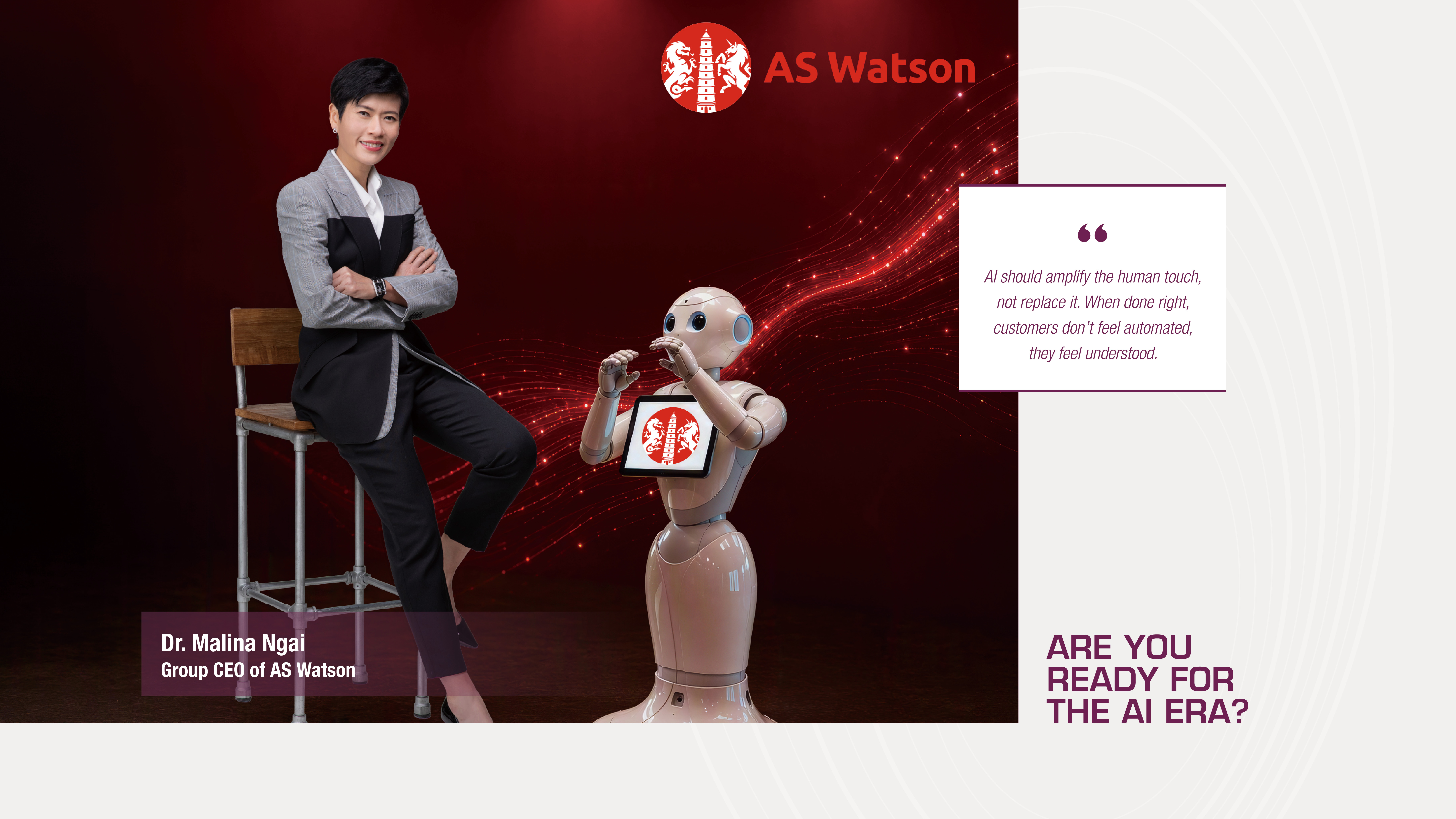
For Dr. Malina NGAI, Group CEO of AS Watson, the world’s largest international health and beauty retailer, artificial intelligence is transforming retail at every level, yet the greatest competitive advantage will come from combining technology with human insight and connection.
Businesses in the retail sector have always sought economies of scale, but the next competitive challenge they face is to optimize the power of artificial intelligence (AI) at scale.
The key to that, according to Dr. Malina Ngai, Group CEO of AS Watson, which operates more than 17,000 stores in 31 international markets, is not to view AI as an incremental upgrade to existing systems. Instead, it should be adopted horizontally across all functions, transforming the way retail organizations function, compete and grow.
“AI is fundamentally reshaping retail, not just as tool to improve efficiency, but as a driver of strategic growth,” she says. “It is moving us from execution at scale to intelligence at scale because it is not a standalone layer of technology, but is becoming a core capability embedded across the entire organization.”
For decades, when retail companies invested in new technology, the results were judged largely on productivity gains and cost controls. The introduction of AI, though, brings a new dimension by allowing companies to rethink how value is created or enhanced.
Rather than simply focusing on processes and automation, they can now take a fresh look at ways to improve everything from customer engagement to supply chain management and executive decision-making.
At AS Watson, AI is empowering teams to prompt in-depth reviews of previously accepted practices, find new efficiencies, and identify potential sources of growth.
Dealing with High Levels of Complexity
When managing thousands of stores in diverse regulatory, cultural and consumer environments, it is essential to pay close attention to both the daily demands and longer-term strategic initiatives.
There must be precision in forecasting, inventory planning and logistics coordination, but also a clear awareness of the impact of external factors and how they can help or hinder new opportunities.
“There is a high level of complexity,” Ngai says. “AI helps us simplify and strengthen that complexity.”
For instance, AI-driven sales forecasting improves accuracy, while automated replenishment reduces stock-outs, overstock, markdowns and waste. Elsewhere, dynamic logistics planning helps to optimize delivery routes and, at the store level, real-time insights allow employees to react more quickly to local sales patterns.
“We have found that AI improves resilience, not just efficiency,” Ngai says. “It helps us anticipate demand shifts, respond faster to trends, and shorten time to market.”
Previously, the way things worked was that retail supply chains reacted to actual sales data. Today, AI helps businesses anticipate demand shifts, respond faster to trends and move from reactive supply chains to predictive and adaptive ecosystems.
Personalization and the Human Touch
While AI is transforming the back end of the retail sector, its impact is most visible when it comes to redefining the customer experience. The watchword nowadays is personalization, but it would be wrong to assume that automation alone produces better engagement with individual shoppers.
“The best personalization is the kind customers don’t consciously notice,” Ngai says. “It shouldn’t feel like AI is involved at all.”
Behind the scenes, algorithms power tailored product recommendations and contextual reminders. However, the key is not the amount of technology an organization deploys, but how it improves the customer’s sense of care and relevance.
“In retail, trust often comes from human interaction,” Ngai says. So, while AI may analyze conversation with high-performing customers, it is frontline engagement – ideally empathetic and informed – that counts the most.
“AI should amplify the human touch, not replace it. When done right, customers don’t feel automated, they feel understood.”
When framed like this, personalization is not about precision targeting, but about reinforcing trust, with careful use of data to enhance the human connection.
Redesigning Workflows and Finding Balance
As AI becomes integral to all core business processes, it will be ever more critical for corporate executives to know where algorithms are leading and when to intervene. They must also come to terms with a new division of labor and its implications.
“In my view, AI excels at speed, scale and analysis. Humans provide judgment, creativity and accountability. The real advantage comes when both work together.”
To find the right balance requires redesigning workflows and redefining roles in order to remove friction, empower teams, and act on insights without undue delay. “The role of leadership is to remove organizational friction so people can act on insights, make decisions faster and focus on creating value,” she says. If AI is positioned as an assistant or partner, employees can become more productive and more creative.
For this to happen, though, companies must undertake a cultural transformation, led from the top and with every department in step, rather than working on separate pilot projects in different markets.
“AI is not an IT initiative. It is a CEO mandate,” Ngai says. “The biggest challenge is not implementing AI. It is helping people let go of old ways of thinking. Too often, companies focus on using AI to automate existing processes. The real opportunity is to rethink how work gets done and redesign workflows around AI.”
This also requires leaders to ensure AI is adopted in a way that builds trust across the organization.
"As AI becomes embedded into decision-making, governance becomes increasingly important. Technology creates new possibilities, but governance creates confidence and trust. Organizations must ensure AI is deployed responsibly, transparently and with appropriate accountability."
She adds, “Technology alone does not transform an organization. People do. Leaders must create confidence, curiosity and culture for teams to experiment, learn and adapt. When that happens, AI becomes a catalyst for innovation and growth, not just efficiency.”
For Ngai, this partnership between people and technology will define the next generation of successful organizations. “The future belongs neither to humans alone nor AI alone, but to organizations that combine the strengths of both.”
In parallel, AS Watson has also shifted away from a traditional ROI (return on investment) mindset when evaluating costs, risks and expenditure. Internal discussions are now more concerned with the extra value AI can create across the business and how that can be scaled.
Once proven, high-impact cases are embedded into workflows and new applications continue to emerge, all of which allows the organization to keep learning and progressing.
For students and young professionals everywhere, the same objectives now apply. The priority is not to compete with AI, but to collaborate with it by knowing how to frame questions, interpret outputs, and apply insights responsibly.
That said, looking five to 10 years ahead, Ngai foresees a retail sector where the human factor will be more, not less, important. Technology will be there, but in the background, as seamless personalization and predictive systems become baseline expectations. Companies will gain a competitive advantage by integrating AI into their organizational DNA, while still preserving authenticity and trust.