


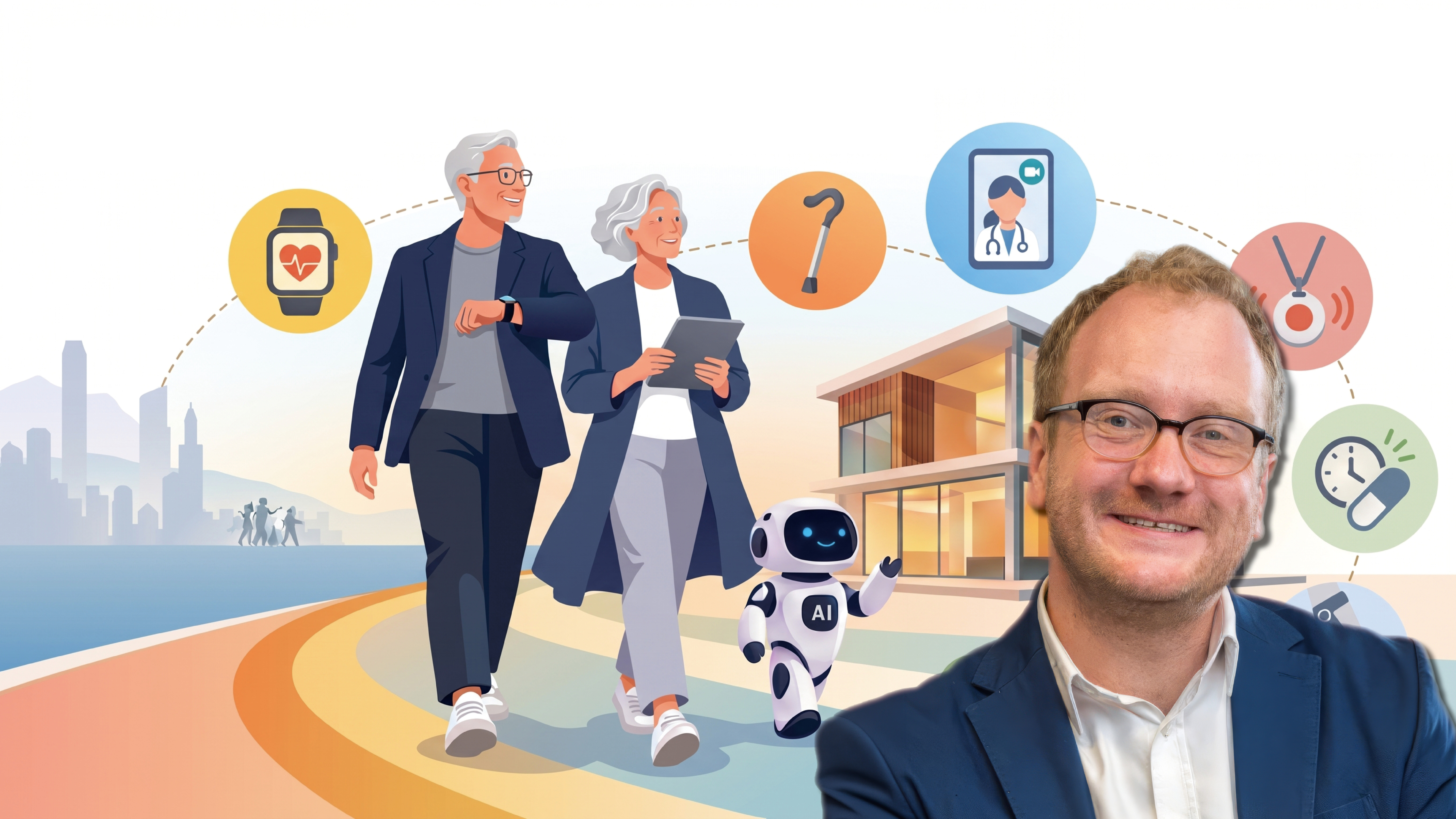
Longer lives are reshaping economies around the world. Companies that design products and services with older adults — not just for them — can reduce the cost of care, improve quality of life and unlock an engine of industrial development.
Authored by Stuart GIETEL-BASTEN
We are living through one of the great transformations in human history: the aging of the world’s population. The reflex is to treat this as a problem, a wave of dependency bearing down on shrinking workforces. That framing is only half the story. The same demographic shift is also one of the largest economic opportunities of the century: the so-called silver economy. China has already identified it as a strategic industry worth around RMB 7 trillion, projected to reach RMB 30 trillion by 2035.
One of the most promising — and most misunderstood — corners of the silver economy is gerontechnology. At its broadest, gerontechnology is any technology designed for use with and by older people.
The real opportunity, however, is not confined to older consumers. The demands gerontechnology makes of designers are not age-specific. Clarity, accessibility, durability and dignity are simply the hallmarks of good design, and products that work for someone who is 80 usually work better for everyone else too. That is what makes gerontechnology an engine of industrial development in its own right, and not merely a niche.
What I Mean by Gerontechnology
It helps to think of a spectrum of complexity. At the simplest end, gerontechnology is nothing new at all: the walking stick, the Zimmer frame and even the rocking chair are early examples.
At the other end sit highly advanced robotic devices that assist with instrumental care, increasingly powered by integrated artificial intelligence, which can detect falls, monitor wellbeing, remind people to take medication and even have a conversation.
In between lie age-friendly phones, apps and digital services, as well as technologies for physiotherapy and exercise tailored to older bodies.
Two points matter here. The first is setting: while the home is an obvious market, community and clinical settings are a major growth area — partly because the cost of some devices is simply prohibitive for an individual household, which makes pooling resources at community level so sensible. A rehabilitation robot, for example, may spend much of its time idle in a single household, but can be used by many people in a community center or residential care home.
The second, and more important, point is conceptual. Most of these products are not really for older people alone. A great many serve anyone with limited mobility or particular health needs at any age.
Why It Matters
The value of this field rests on four connected benefits.
First and foremost, these technologies should improve the lived experience of older people themselves — their mental and physical wellbeing, their ability to age in place, and their capacity to live life to the full for as long as possible. Second, gerontechnology can support caregivers and families. Most care for older people is informal, unpaid and provided by family or community members — disproportionately by women — and well-designed tools can relieve some of that burden. They might even make the care sector more appealing to younger workers, for whom it currently holds little draw.
Third, if we can improve older people's wellbeing and lighten the load on carers, we can lower the overall economic and social costs of health and long-term care — a benefit with real macroeconomic weight. Across OECD countries, spending on long-term care already averages around 1.8% of GDP and is projected to continue rising by around 2.6% a year until 2050 as populations age.
Fourth, gerontechnology is itself an engine of industrial development: not just products to sell, but new capabilities built within a region's innovation ecosystem. The European Commission has identified the silver economy as a source of new markets across healthcare, transport, tourism, education and digital services. It has backed that opportunity with more than 400 aging and health research projects worth around €1 billion under Horizon 2020, the research framework.
Governments are investing too. Hong Kong has committed HK$2 billion to expand the use of gerontechnology in elderly and rehabilitation care, while the Hong Kong Jockey Club Charities Trust has invested heavily in programs that help older people age at home using technology.
What Separates Good Gerontechnology from Bad
The promise is real, but it is not self-executing. Whether these four benefits are actually realized depends on how these technologies are designed and deployed. Several principles stand out.
First, products and services should be designed in a human-centered way — with older people and caregivers, not merely for them. Second, they should be designed for sustainability and affordability from the outset. That applies not only to the technology itself, but to the business models that determine who can actually use it. Digital interfaces should anticipate where users will get lost or stuck.
Affordability is the hard part. There is a strong argument for pooling resources at community level for devices that do not need constant individual use, which is very much the model Hong Kong is developing. If this technology is to be genuinely transformative rather than a luxury for the middle class and above, affordability has to be designed in. Crucially, most of this growth will not take place in the wealthy world but in low- and middle-income countries, which will have to prepare for rapid aging while still building their health and social systems.
Reliability matters in two quite different ways. In robotics used for instrumental care, a malfunction can have severe physical consequences. In AI and digital services, the danger is a betrayal of trust: older people are too often targets for scams, and those with lower digital literacy can have genuinely harmful encounters unless systems are trustworthy by design.
That shades into a fourth principle — ethics and privacy. As more information is gathered about older people in the home, the clinic and the community, protecting that data, and ensuring older people understand what is collected and by whom, is not optional. A technology that enables independent living can quickly undermine trust if users do not understand what information is being collected or how it is used.
The deepest principle of all is this: gerontechnology should supplement human relationships and human work, not supplant them. Consider AI phone calls designed to ease loneliness. Used well, a daily AI call can check on someone or hold a tailored conversation. Used badly — marketed, as it sometimes is, as a way for busy professionals to outsource calling their own parents — it hollows out the very relationships it claims to serve.
Why Hong Kong and the Greater Bay Area Can Lead
Getting all this right requires accepting that gerontechnology is not purely an engineering or business proposition. A start-up of talented twenty-something engineers working in isolation is unlikely to build the best products for older people. What is needed is genuinely multidisciplinary teams. Above all, older people and their caregivers must be present throughout, from inception through piloting to evaluation. That, in turn, demands deep collaboration between universities, the public sector and private industry throughout the innovation process.
Hong Kong has an unusual amount of this infrastructure already. The Government has recognized gerontechnology's importance and is investing. The annual Gerontech and Innovation Expo cum Summit in Hong Kong has drawn over 1,000 exhibitors, showcased more than 3,500 products and attracted over 230,000 visitors since 2017. At the university level, Hong Kong probably has a greater concentration of research groups working on gerontechnology than anywhere on earth, spanning all eight public universities.
Five takeaways
1.Treat Gerontechnology as a Design Standard, Not a Product Category
Gerontechnology is designed with and for older people, but the qualities that make it successful benefit users of every age. Designing to the standard older users require raises the floor for everyone, widens the market and improves the product.
2.Design with Older People and Caregivers, from Day One
Involve users, caregivers and clinicians from inception through evaluation, and assemble multidisciplinary teams spanning engineering, the social and clinical sciences, business, policy and the humanities. Isolated engineering teams rarely build what older people actually need.
3.Make Affordability, Reliability and Privacy Non-Negotiable
Pool resources at community level for costly or infrequently used devices; build for real-world wear and tear; design affordability into both the technology and the way it is delivered; and protect older people's data transparently. A tool that is unaffordable, unreliable or untrustworthy fails the people it is meant to help.
4.Supplement Human Relationships — Never Supplant Them
The best gerontechnology augments human care and connection; the worst quietly replaces it. Use automation to remove menial burdens and free people for the relational work that matters most.
5.Play To the Region's Strengths
Hong Kong and the Greater Bay Area combine rapid aging, world-leading research, strong community test beds, public and philanthropic funding, and Guangdong's industrial base. Together, under the 15th Five-Year Plan, the opportunity is in turning those complementary strengths into products, services and industries that neither side could develop alone.
The opportunity ultimately extends well beyond better care for older people. It is about creating entirely new industries built around one of the defining demographic shifts of our time.
Stuart GIETEL-BASTEN is an associate director of the Center for Aging Science and a professor of social science and public policy at HKUST, with research interests in how demographic change shapes public and social policy. He is Deputy Project Co-ordinator of the RGC funded Area of Excellence Project ‘Frontier and Human-centric AI and Robotics Technology for Geriatric Care’ (Project Reference Number: AoE/E-601/24N)