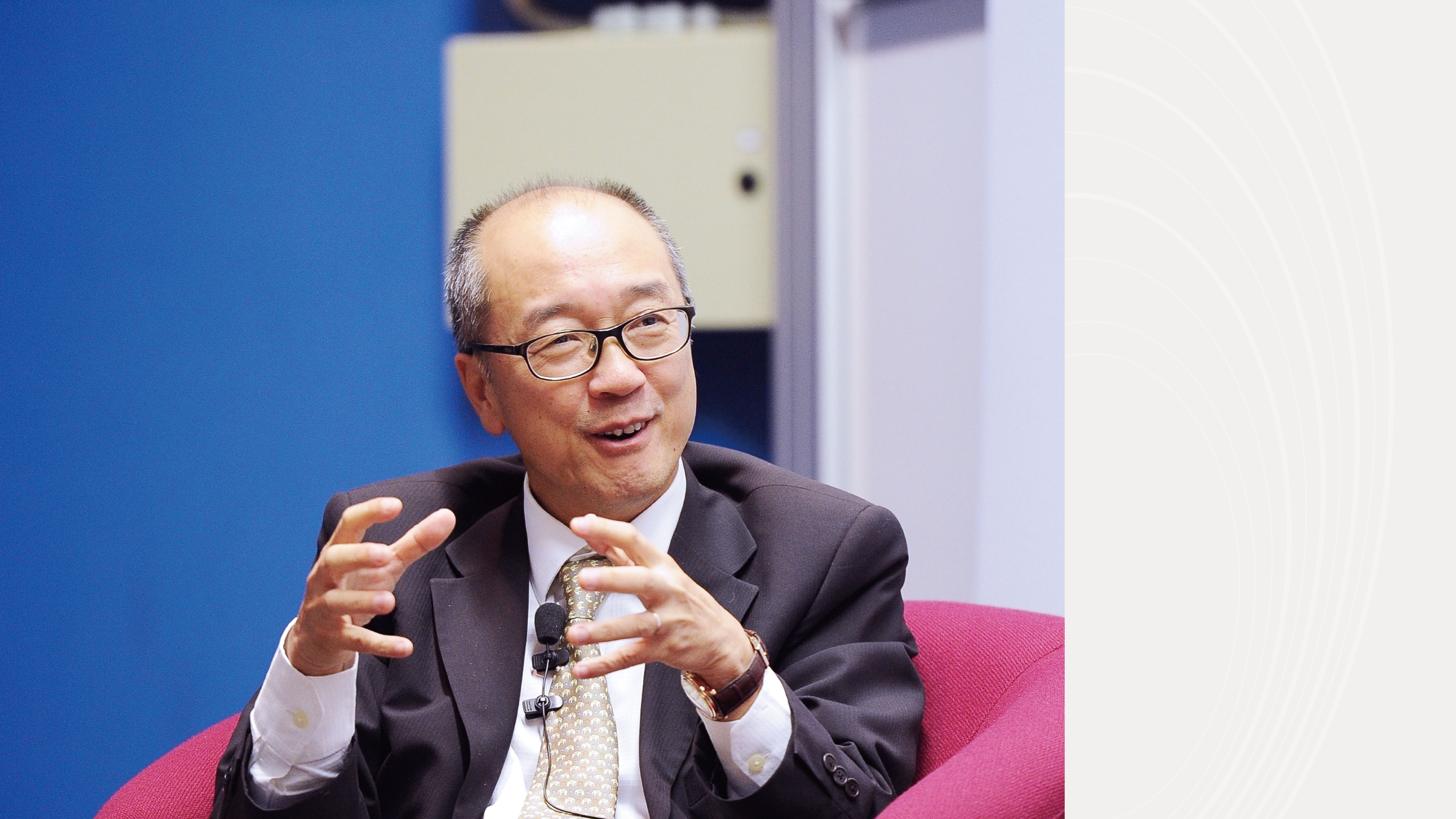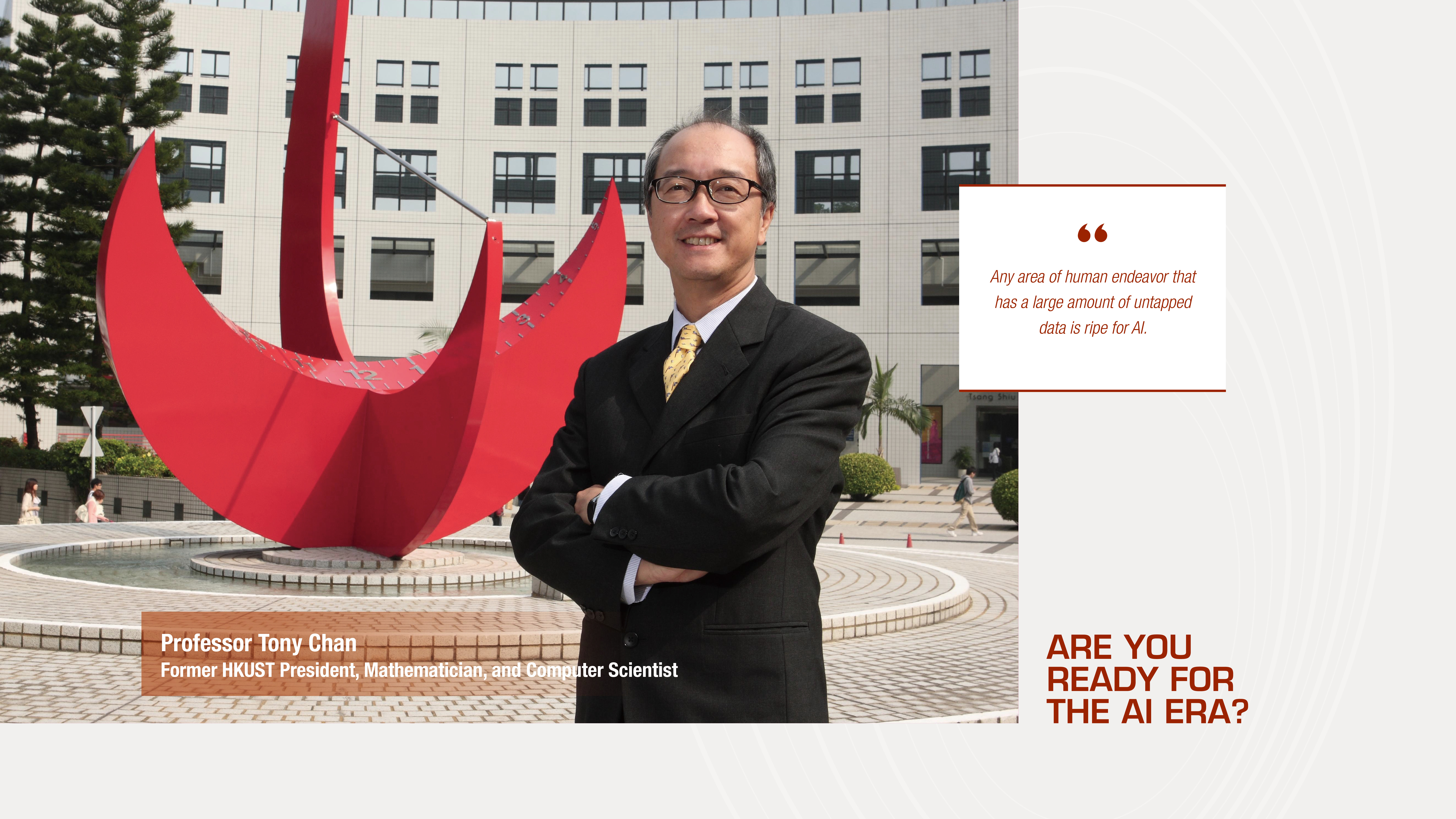
Professor Tony CHAN, former President of HKUST, believes universities must rethink how they develop and equip leaders with the digital fluency to drive responsible innovation.
When Professor Tony Chan calls artificial intelligence (AI) “the new math”, he is not simply reaching for a metaphor, but emphasizing the need for a complete recalibration of standard thinking.
As AI becomes embedded in sectors ranging from energy, finance and logistics to healthcare and public services, it is essential to realize a major shift is taking place, which will transform many aspects of daily life and how we interact with the world around us.
“The reason we learn math is because it is an analytical skill, very precise and very broad,” says Chan, former president of HKUST and of King Abdullah University of Science and Technology (KAUST) in Saudi Arabia. “AI should be seen that way too. It is very important because it helps you think. You have to spend some effort to understand it, but that will pay off in the long term.”
Against that background, the role of universities and business schools also has to change. The urgent task is not merely to teach students how to code, but to develop future leaders who are fluent in the use of AI and adept at applying the tools wisely in complex, real-world situations.
Advancing the Frontiers of Science
During his tenure at KAUST from 2018 to 2024, Chan championed an initiative known as “AI + X” – the idea being that AI should act as an enabler to advance the frontiers of science and address humanity’s most pressing challenges.
“In my opinion, the most important of those challenges is energy writ large,” Chan says. “Without energy, we cannot grow food or survive.”
He adds that the backbone of modern civilization depends on energy, care for the natural environment, food supply, access to clean water, and digital infrastructure. In its own way, each is the source of vast amounts of data, much of it underexploited, but offering the chance to unlock all kinds of potential.
“Any area of human endeavor that has a large amount of untapped data is ripe for AI,” says Chan, citing the example of oil giant Saudi Aramco, which has accumulated decades of operational information on everything from exploration to refining and distribution.
“In principle, they can use that data to further optimize their operations. But they have also formed an AI division to help run their business, and they want to sell AI as a product.”
There is a clear lesson here for other traditional sectors: competitive advantage lies in adopting AI and deeply integrating AI with domain expertise. The technology then becomes an accelerator of scientific insight, while also streamlining processes and solving persistent problems.
Reciprocal Relationships
However, Chan resists the idea that AI is a self-contained revolution. Rather, today’s breakthroughs in the field rest on generations of work in mathematics, physics, chemistry and biology. For example, AlphaFold (a Google DeepMind system that predicts 3D structures of proteins) did not emerge from nowhere. It “stands on the shoulders” of the biochemists who built the underlying datasets.
Such relationships between different disciplines can and should be reciprocal. AI models are learning from science, especially neuroscience, but the hope is that they will also bring new understanding of the human brain and how it functions.
For instance, neuroscientists know that glial cells support and regulate neural activity and are crucial to the efficiency of brain and nerve functions. So far, machine learning architectures have barely begun to incorporate such insights, but there is plenty of scope.
“I think the next wave of AI should really combine current tech developments with insights from neuroscience, not to imitate the brain, but to extract new levels of understanding,” Chan says. “I could compare the concept to flying an airplane, which takes off but doesn’t flap the wings.”
Nevertheless, he remains sceptical about artificial general intelligence (AGI) – a hypothetical type of computer software able to match or beat human thinking in any intellectual task – at least in the near term.
“All you have to do is look at the geniuses – Einstein, Mozart or Picasso. I don’t think they worked in a probabilistic way. Their creativity was based on something that humans don’t yet understand.”
In contrast, current large language models rely on existing data, and if that is limited, there is no way for them to squeeze more from a “dry towel”.
Thinking Ahead of the Crowd
For organizations and businesses, there are clear implications in terms of the strategies they must adopt. Besides optimizing the present architecture, they also have to invest in the next iteration.
In particular, as universities pivot to produce future leaders who are AI-fluent, the focus should not be on training more people to write code, but instead to make sure every graduate understands enough to “look under the hood” and tell what AI is doing right or wrong.
Achieving that degree of tech literacy means knowing what systems can and cannot do and being able to distinguish what is fake, what is a signal, and what is just noise.
“The role of a university is to think ahead of the crowd,” Chan says. “That involves questions about ethics, philosophy, truth, and what rapid change could mean for humanity. Remember that trust is the foundation of human society.”
In his view, universities must also fix their internal incentive systems, so that interdisciplinary work does not carry hidden penalties. At HKUST, the goal should be to balance strong foundations in math, science and logic with the chance to build bridges to other fields.
Ultimately, Chan’s message is neither utopian nor alarmist. He sees AI as transformative, but only if guided by judgment, discipline and humility.
As a general reminder, he notes that universities are not factories, there to turn out graduates with more or less identical skills and ambitions. The priority is to cultivate analytical depth, ethical awareness, interdisciplinary courage and critical thinking.
The best way to do that in the present era is to regard AI as the new math – a foundation on which to build institutions capable of turning potential into lasting impact.