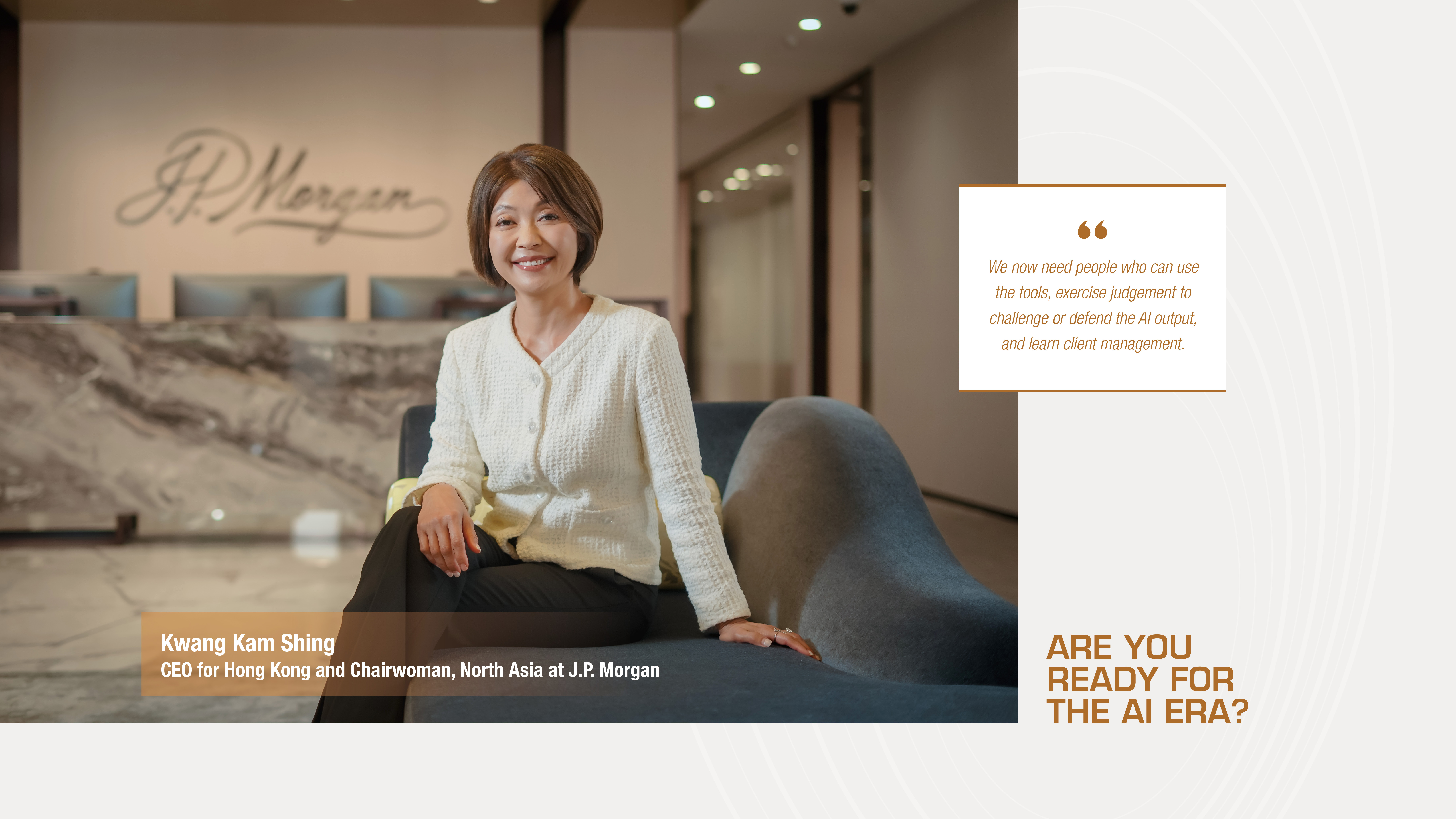
For KWANG Kam Shing, CEO for Hong Kong and Chairwoman, North Asia, at J.P. Morgan, adoption of new technology must be embraced at all levels.
Artificial Intelligence (AI) is attracting massive investment, reflecting a broad consensus that this new technology frontier will have a transformative impact far beyond business and education into almost every aspect of daily life.
Alongside the expected benefits, though, come predicable concerns in many quarters about what the coming changes will mean.
In some cases, those uncertainties relate to future job and career prospects, as employers across sectors talk up the potential of AI helping to improve efficiency, reduce costs and train robots.
In others, the questions center on how these advances in technology will reshape society and the way we live.
For example, will studying for a diploma or degree become largely a matter of keying in prompts and queries? Could a 20-hour work week become the norm? And how will human behavior and interactions evolve if AI has all the answers and is always one step ahead?
With so much happening, senior leaders such as Kwang Kam Shing, CEO for Hong Kong and Chairwoman, North Asia, for J.P. Morgan, know their organizations must stay ahead of what comes next in order to maximize opportunities, minimize anxieties, and point the way forward as inevitable evolution takes place.
“When I meet employees across different levels, the most popular question is about how AI will impact them and their job prospects – and how to prepare their children,” Kwang says. “This issue is top of mind in Hong Kong, so in town halls and regular updates I want to be open about it, reminding people it is not without challenges, but that’s life, so let’s manage it.”
If she senses any “glass half empty” feedback in these encounters, Kwang will point out that most powerful tools, past and present, have come with some downsides as well as equal if not more upsides. The task now is to gain clarity, invest in ourselves as necessary, and recognize that there will be more breathtaking leaps in the years ahead.
She adds that J.P. Morgan is an example of a major financial institution investing in AI for more than a decade, leading to a steady increase in hiring specialists from across the technology sector, people who wanted to get out of the lab and move into more practical roles.
Change of Culture
The big shift came with the launch of generative AI in late 2022, which made these tools accessible to everyone and soon embedded them in the bank’s day-to-day workflow.
“To some extent, we’ve had to shift the culture and mindset of employees, so they were ready to embrace it and willing to be trained,” says Kwang, who notes that, besides being an early investor, the bank’s senior management team has long maintained close contact with innovators in Silicon Valley to understand what is coming next.
“Hopefully, everyone feels they are participating in this ongoing journey, and that takes away the fear factor.”
For individuals, the important thing has been to understand the scale and synergies of what can be done with AI, which has moved quickly from automation to predictive models, then to reasoning, solving complex problems, and acting as an agent for users.
During successive adoption phases, the aim has been to prioritize high-impact use cases specific to different lines of business or particular tasks, approaching each from the bottom up, since that is usually the best way to identify and solve pain points.
“We try something out, see what works for us, and then iterate if it does,” Kwang says. “We’ve been leveraging AI and machine learning for over a decade to drive efficiency, improve client service, and support critical business functions across the firm.”
For the first of these use cases, AI offers the ability to capture and synthesize large quantities of data and detect suspicious patterns of activity, as well as speed up the drafting of lengthy and complex documents.
“It is very effective and precise, with a high degree of accuracy,” Kwang says. “For KYC (know your customer), AML (anti money laundering), market research and analysis work, it increases overall productivity. And relationship managers are using it to understand client needs, draw new insights, and have everything at their fingertips when giving updates or advice.”
Extensive Impact
Clearly, these developments will continue to have an impact as current scope of work and roles are redefined and new measures are used to recruit, assess and deploy talent, whether at entry level or further up the organization.
However, amid this period of change, certain things will always remain the same.
“For instance, when hiring graduates, we still look for people who are curious, have critical thinking skills, and can ask the right questions,” Kwang says. “Five or 10 years ago, we used to hire highly educated analysts to do routine spreadsheets and KYC reports. Today, that, to a certain extent, can be done by AI. So, we now need people who can use the tools, exercise judgment to challenge or defend the AI output, and learn client management.”
In essence, the entry ticket to the world of banking comes down to expertly combining technical fluency with the latest tools, together with an analytical mindset and personal integrity, good communication skills and, of course, adherence to the ethical standards the industry demands.
Accepting that AI is by no means flawless and that the answers produced may not be clear-cut. Kwang’s own practice is to use different models, ask different questions, then cross-check the conclusions given and decide what makes the best sense. This final decision remains a human judgement.
“It is like sitting in a room with people with differing opinions or with two experts,” she says. “Sometimes, the outcomes suggested could be quite different from what you think is right, but that is where judgment comes in. You can also point out where AI has made a mistake, and the more you use it, the better it will be,”
More generally, Kwang is confident that, despite some of the negativity expressed, new jobs and new roles will be created. Already, the bank is adding positions in data management, risk and governance, but with the caveat that the work will not be done in the same way as before.
Ever since we started investing in AI, we have had net hiring in Asia every year,” she says. “There will always be changes, though, and attempts to do even more with new tools.