




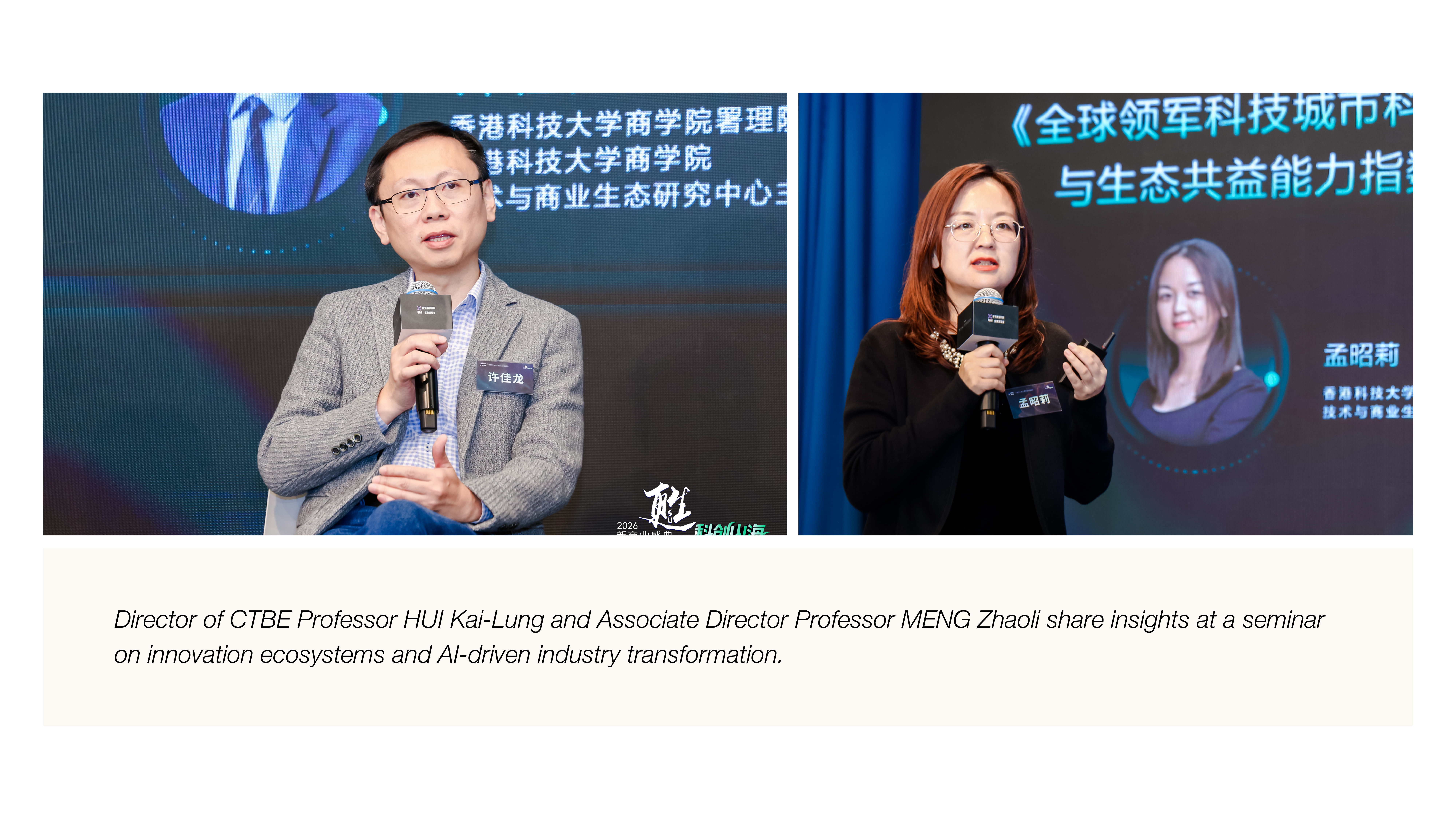
HKUST Business School’s new Center for Technology and Business Ecosystem studies how AI-driven technologies reshape business strategy and collaborative ecosystems.
The rapid advance of artificial intelligence (AI), robotics, and other frontier technologies is transforming not only how companies innovate, but also how they interact with partners, platforms, and competitors today.
Recognizing this shift, the HKUST Business School launched the Center for Technology and Business Ecosystem (CTBE) in mid-2025 to examine how business strategies and ecosystem structures are evolving in the AI age, and how best can business leaders respond to this change.
“As disruptive technologies continue to reshape business ecosystems and strategies, success in the AI age depends on fostering symbiotic relationships between ecosystem players,” said Professor HUI Kai-Lung, Director of CTBE and Associate Provost (Academic Development) of HKUST.
To this end, CTBE focuses on how emerging technologies are reshaping competitive dynamics at the ecosystem level. Rather than analyzing firms in isolation, the Center adopts a systems perspective, examining how value is created and governed across interconnected networks, explained Professor Hui.
“From product design and organizational structure to platform governance, we aim to decode the collaborative dynamics in the AI era,” he said. “By analyzing these forces, we hope to enable businesses to strategically position themselves for long-term success in a tech-driven era.”
A distinctive strength of the Center lies in its close connection to practice. “Grounded in the practices of leading Chinese tech firms and integrated with cutting-edge global theory, CTBE aims to develop forward-looking and actionable strategic frameworks and guidance,” said Professor Hui. With China’s innovation and technology sector continuing to make rapid advances, its dynamic business environment provides what he described as “a fertile ground for the Center’s research.”
Looking ahead, CTBE aims to become a globally influential think tank for technology-driven ecosystem studies. Its plans include the regular release of insight reports, co-developing case libraries with industry leaders, and hosting cross-sector dialogues on key technology and strategy issues. The Center is also committed to promoting greater awareness of the potential of emerging technologies in business among tertiary students, reinforcing its educational mission.
In all, collaboration is central to CTBE’s vision. “By building an inclusive and innovative research network, CTBE is committed to fostering deep collaboration among academia, industry, and policymakers,” Professor Hui said. The Center will also strengthen strategic ties between Hong Kong SAR, the Greater Bay Area, and Chinese Mainland, supporting coordinated development of the regional technology ecosystem.
As AI, robotics, blockchain, and quantum computing continue to reshape global commerce, CTBE positions itself as a hub for insight and dialogue—advancing a research paradigm based on cross-boundary collaboration, systems innovation, and ecological symbiosis in the digital era.